
Why Most Ecommerce Stores Fail Before Their First Sale (And How AI Changes Everything)
Why Most Ecommerce Stores Fail Before Their First Sale (And How AI Changes Everything)
Most ecommerce sellers assume their biggest challenge is finding winning products.
It isn't.
The real problem starts much earlier.
Before the first visitor arrives.
Before the first ad runs.
Before the first sale happens.
Most stores fail because they launch too slowly, cost too much to build, and struggle to convert traffic into buyers.
That is why so many merchants burn through ad spend without seeing meaningful results. They spend money driving traffic to stores that were never built to sell efficiently in the first place.
If you're searching for how to create a website to sell products, you're probably not looking for a design tutorial. You're looking for a faster path to revenue.
That is exactly where AI changes the game.
Manual store building is no longer the best way to launch. AI is making it possible to create, test, and optimize ecommerce stores much faster than traditional workflows ever allowed.
The path forward is clear: AI comes first, then store creation, then ecommerce performance, and xPage brings those pieces together into one system.
AI: The Problem with Traditional Ecommerce
The old ecommerce model is built on friction.
A seller finds a product they want to test, then spends hours or days trying to turn that idea into a store. They choose a platform, install apps, customize a theme, write product copy, upload images, and fix layout issues before they can even start collecting data.
That process made sense years ago.
It doesn't now.
Manual store building is slow, repetitive, and expensive. Worse, it forces sellers to spend time on tasks that do not directly generate revenue.
The reality is that most people searching for how to create a website to sell products are not trying to become web designers. They want to launch a store that can start selling as quickly as possible.
AI is changing that expectation.
Instead of manually creating every page, writing every description, and adjusting every layout by hand, AI can now help with the parts that usually slow sellers down the most:
- Product descriptions
- Store structure
- Landing page copy
- Visual organization
- Messaging hierarchy
- Conversion-focused layouts
That matters because speed is not just convenient in ecommerce. Speed is a competitive advantage.
The faster you launch, the faster you learn.
The faster you learn, the faster you improve.
And the faster you improve, the more likely you are to find a product-market fit before your competitors do.
This is why AI is becoming the foundation of modern ecommerce. It removes the bottleneck between product idea and live store.
Store Creation: The Bottleneck That Slows Sellers Down
For most merchants, store creation is the part that drains time, money, and momentum.
The phrase how to make a website to sell sounds simple. In practice, it usually turns into a long list of decisions:
- Which platform should I use?
- Which theme looks best?
- Which apps do I need?
- How do I write the copy?
- How do I make it mobile-friendly?
- How do I make it look trustworthy?
- How do I launch without technical issues?
That complexity is exactly why so many stores never make it to market.
People who want to know how to make a website to sell stuff usually want one thing: a store that works without requiring a full technical team. They want to move from idea to launch without getting stuck in setup mode.
The same problem shows up for merchants trying to figure out how to build a website to sell products or how to build a website to sell things.
The issue is not that building a store is impossible.
The issue is that manual store creation is too slow for modern ecommerce.
Speed matters because product testing depends on it.
If you can launch quickly, you can test more offers, more creatives, and more product angles. If you can test more, you can identify winners faster. And if you can identify winners faster, you can scale with more confidence.
That is why the old workflow creates such a serious disadvantage.
Traditional store creation
Traditional store creation usually means:
- Multiple subscriptions
- Manual page building
- Copywriting from scratch
- Theme customization
- App setup
- Technical troubleshooting
Every step adds friction.
Every delay reduces momentum.
AI-powered store creation
AI-powered store creation changes the process completely.
Instead of starting from a blank page, sellers can generate the core structure of a store much faster. Instead of spending hours writing and formatting, they can focus on product selection, offer quality, and launch speed.
That shift is especially important for merchants who are tired of template fatigue. Many stores look polished but still fail because they were built slowly and without a clear conversion strategy.
AI helps solve that by making store creation faster, more consistent, and more scalable.
For sellers who are serious about growth, the goal is no longer just to build a website.
The goal is to build a store that can be tested, improved, and scaled without wasting time.
Ecommerce: What Actually Drives Revenue
Once the store is live, the real work begins.
This is where many sellers make a mistake. They assume the store itself is the product.
It isn't.
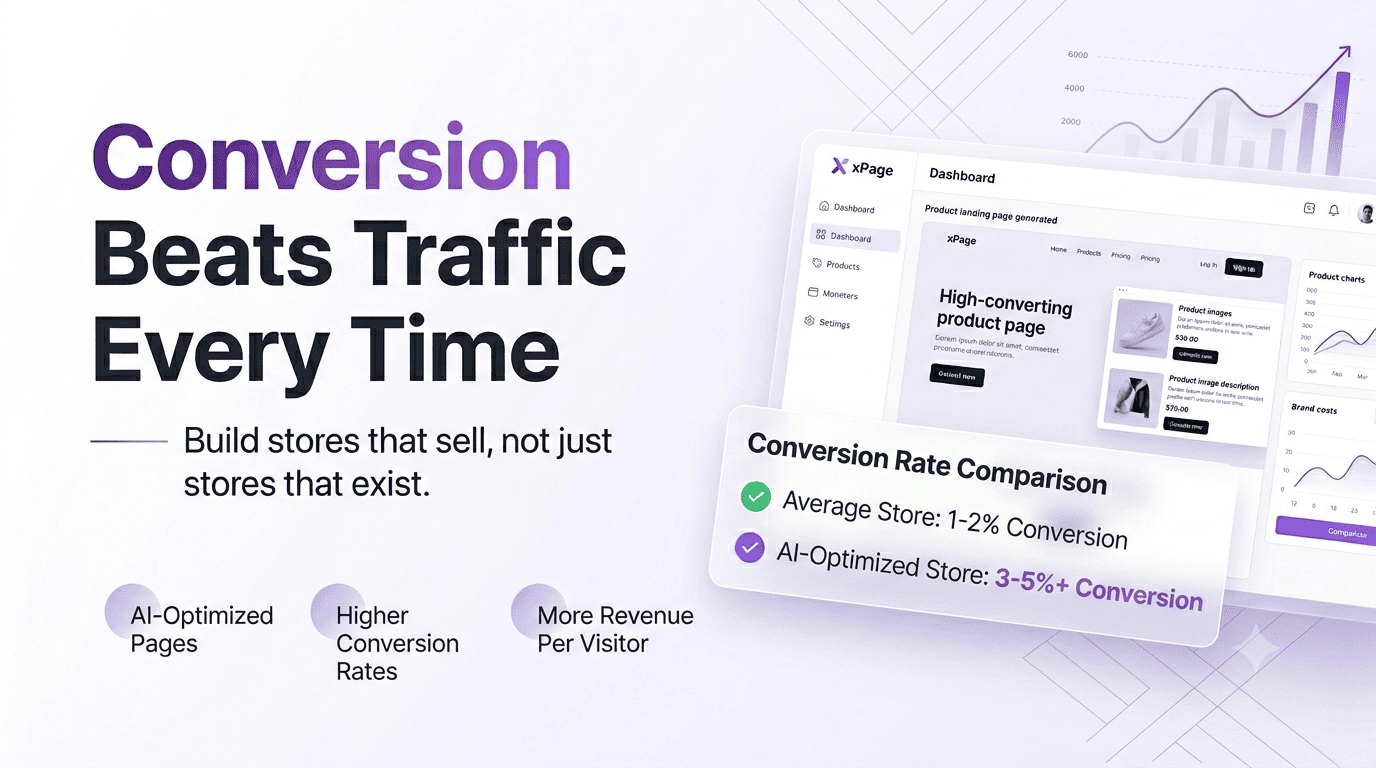
The store is the container. Revenue comes from conversion.
That is why ecommerce success depends less on how a store looks and more on how it persuades.
A high-converting product page answers the questions buyers are already asking:
- What does this product do?
- Why should I trust this store?
- Why is this worth the price?
- What makes this better than alternatives?
- Can I buy without risk?
If the page does not answer those questions quickly, traffic leaks away.
That is a major problem in today's market because traffic is more expensive than ever. Ad costs keep rising. Margins keep tightening. Competition keeps increasing.
For merchants starting a website to sell products, this means the store has to do more than exist. It has to convert.
That is also why the question how do you make a website to sell things is really a conversion question, not just a technical one.
The answer is not simply choosing a platform or picking a theme.
The answer is building a buying experience that reduces doubt and increases confidence.
What high-converting ecommerce pages do well
The best product pages usually include:
- Clear product benefits
- Strong social proof
- Simple, persuasive copy
- Trust signals
- Fast-loading design
- Easy checkout flow
These elements matter because ecommerce is psychological.
People do not buy because a page is pretty.
They buy because the page makes the decision feel safe, obvious, and worthwhile.
AI is becoming increasingly useful here as well.
Modern AI tools can help merchants improve product descriptions, organize information more clearly, and highlight the details that matter most to buyers. They can also help structure pages in a way that supports trust and reduces friction at checkout.
That is especially valuable when traffic is expensive.
If every click costs more, every page has to work harder.
If margins are shrinking, every conversion matters more.
And if competition is increasing, the stores that win will be the ones that turn traffic into revenue more efficiently.
This is why ecommerce is no longer just about launching a store.
It is about launching a store that sells.
xPage: The AI-Native Solution for Modern Sellers
Most ecommerce platforms were built before AI became central to how merchants operate.
Over time, they added AI features.
xPage was built differently.
xPage is designed as an AI-native ecommerce platform, which means AI is not an extra feature layered on top. It is part of the core workflow from the beginning.
That matters because it solves the exact problems that slow sellers down:
- Slow launches
- Manual setup
- Design bottlenecks
- Copywriting delays
- Too many tools
- Too many subscriptions
With xPage, a product link can become a ready-to-sell store in minutes.
That is a major shift for merchants who want to move quickly without sacrificing quality.
Instead of spending days trying to figure out how to make a store from scratch, sellers can focus on what actually drives growth:
- Product validation
- Offer testing
- Traffic acquisition
- Conversion optimization
- Scaling winners
The experience is built for serious sellers who do not want to waste time on technical setup.
No coding.
No design skills.
No juggling multiple subscriptions across different tools.
No unnecessary complexity.
Just a faster path from product idea to live ecommerce store.
That is why xPage is more than a website builder. It is a system for launching and growing ecommerce businesses with less friction and more speed.
And in a market where speed matters, that difference is huge.
The Future Belongs to Better Systems
The next generation of ecommerce winners will not necessarily have better products.
They will have better systems.
They will launch faster.
They will test faster.
They will learn faster.
They will scale faster.
That is the real shift happening in ecommerce right now.
The old model rewarded merchants who could tolerate complexity and spend time stitching together tools. The new model rewards merchants who can move quickly, adapt quickly, and build stores that are ready to sell from day one.
AI is making that possible.
Store creation is becoming faster.
Ecommerce is becoming more competitive.
And platforms like xPage are helping sellers turn that pressure into an advantage.
If you're still trying to figure out how to create a website to sell products, how to make a website to sell, or how to make a website to sell stuff, the answer is no longer to start with a blank canvas and build everything manually.
If you're trying to understand how to build a website to sell products or how to build a website to sell things, the better question is whether your system can help you launch, test, and convert faster than the competition.
That is the real advantage.
In 2026 and beyond, the winners will not be the merchants working the hardest.
They will be the merchants using the best systems.
And xPage is built to be that system.