
Why Most Ecommerce Brands Lose Money on Ads (And It's Not Their Products)
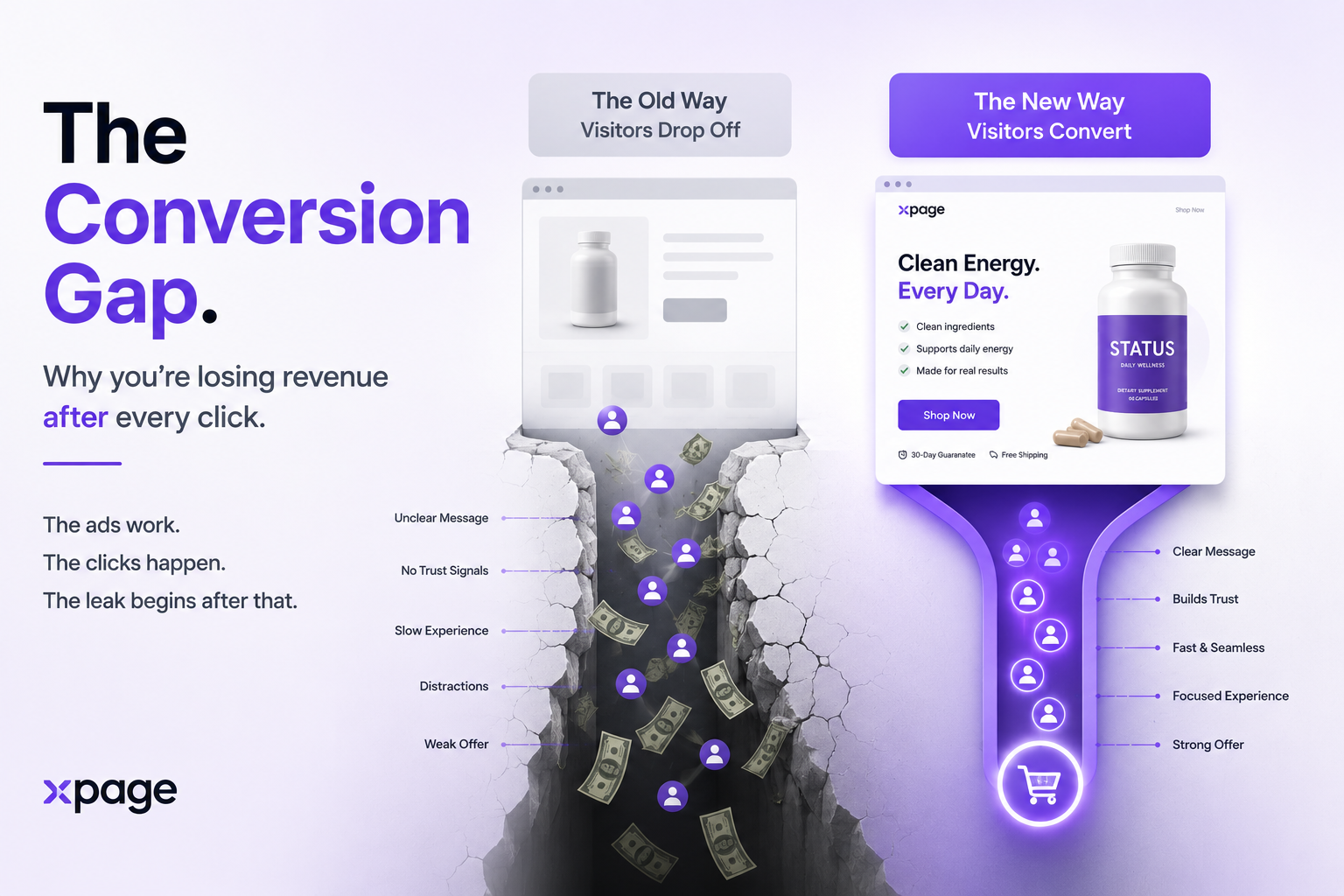
Every Day, Millions of Dollars Disappear
Every day, ecommerce brands spend millions of dollars on Meta, TikTok, Google, and YouTube ads. When sales don't follow, most founders immediately start looking for answers.
- Maybe the product isn't good enough.
- Maybe the ad creative needs to be refreshed.
- Maybe the targeting is wrong.
- Maybe the platform has become too competitive.
But what if none of those are the real problem?
The uncomfortable reality is that many ecommerce businesses are successfully buying attention but failing to convert it into revenue. The ads work. The clicks happen. The visitors arrive.
The leak begins after that.
While most operators obsess over traffic acquisition, the biggest revenue opportunity often sits between the click and the purchase. This hidden gap quietly destroys profitability and forces brands to spend more and more money acquiring customers when they should be focusing on converting the customers they already paid for.
The issue isn't getting visitors. The issue is what happens when visitors arrive.
The $100,000 Experiment:
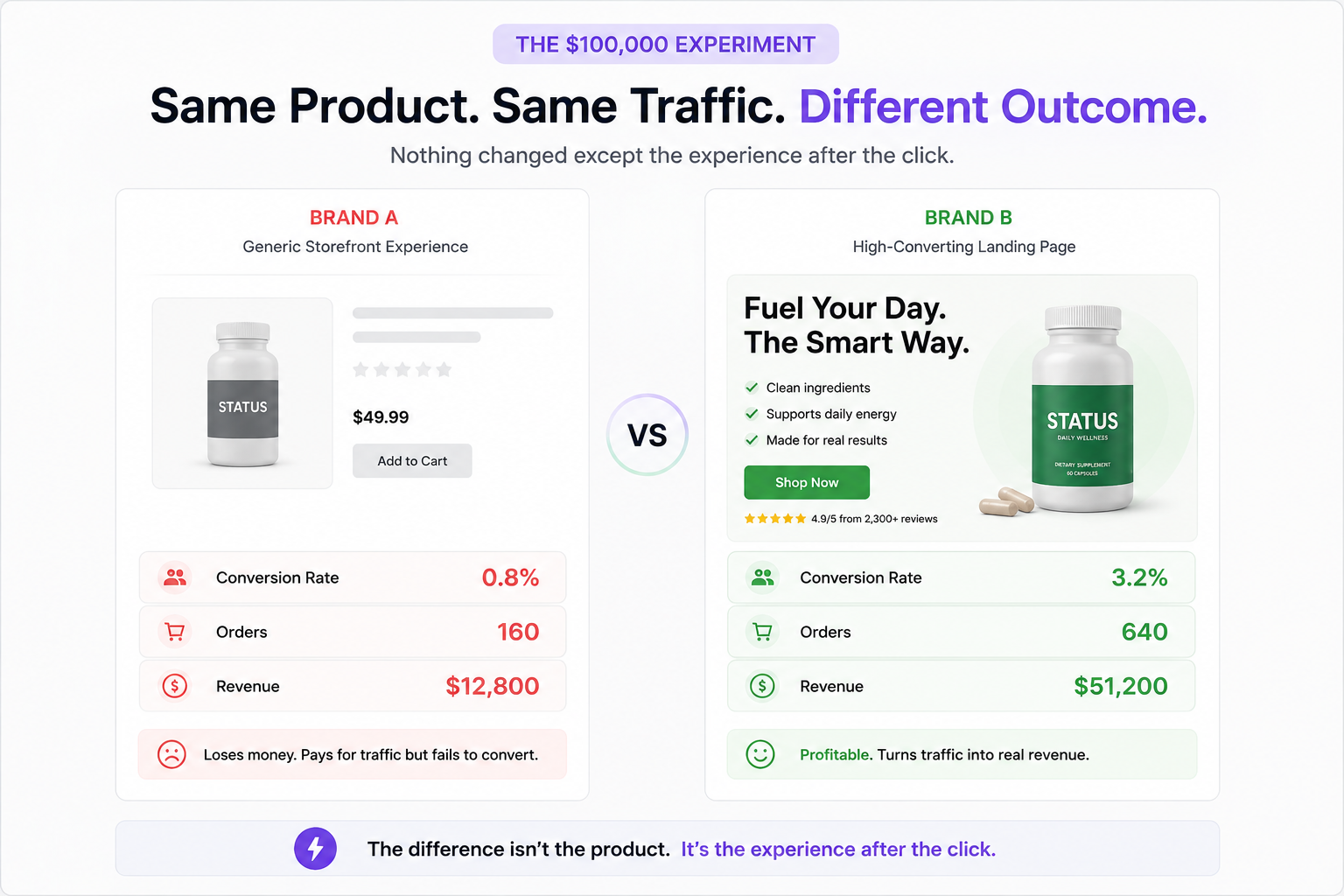
Imagine two ecommerce brands selling products in the same category. Both spend $100,000 on advertising. Both generate similar click-through rates. Both reach roughly the same audience. Both receive around 20,000 visitors. Yet one business generates more than four times the revenue of the other.
Metric                  Brand A         Brand B
--------------------------------------------------
Ad Spend                $100,000        $100,000
Visitors                20,000          20,000
Conversion Rate         0.8%            3.2%
Orders                  160             640
Average Order Value     $80             $80
Revenue                 $12,800         $51,200
Nothing changed except the experience after the click: The products were similar.The advertising was similar.The difference was the page.
One brand treated its landing page as part of the advertising campaign.The other treated it as a place where customers happened to land.
That distinction can determine whether a business scales or struggles.
The Most Expensive Blind Spot in Ecommerce
Ask most ecommerce operators why performance is declining and you'll hear familiar explanations:
- CPMs are rising.
- Competition is increasing.
- Creatives are fatiguing.
- Algorithms are changing.
All of these factors matter.But they only explain the cost of acquiring attention, they do not explain how effectively a business converts that attention into revenue.
Many brands spend weeks optimizing ad accounts while ignoring a product page that is silently cutting their conversion rate in half.This is one of the most expensive mistakes in modern ecommerce.
Because every conversion problem amplifies every advertising problem:
- A weak page makes every click more expensive.
- A weak offer makes every visitor less valuable.
- A weak buying experience makes scaling almost impossible.
The Conversion Gap
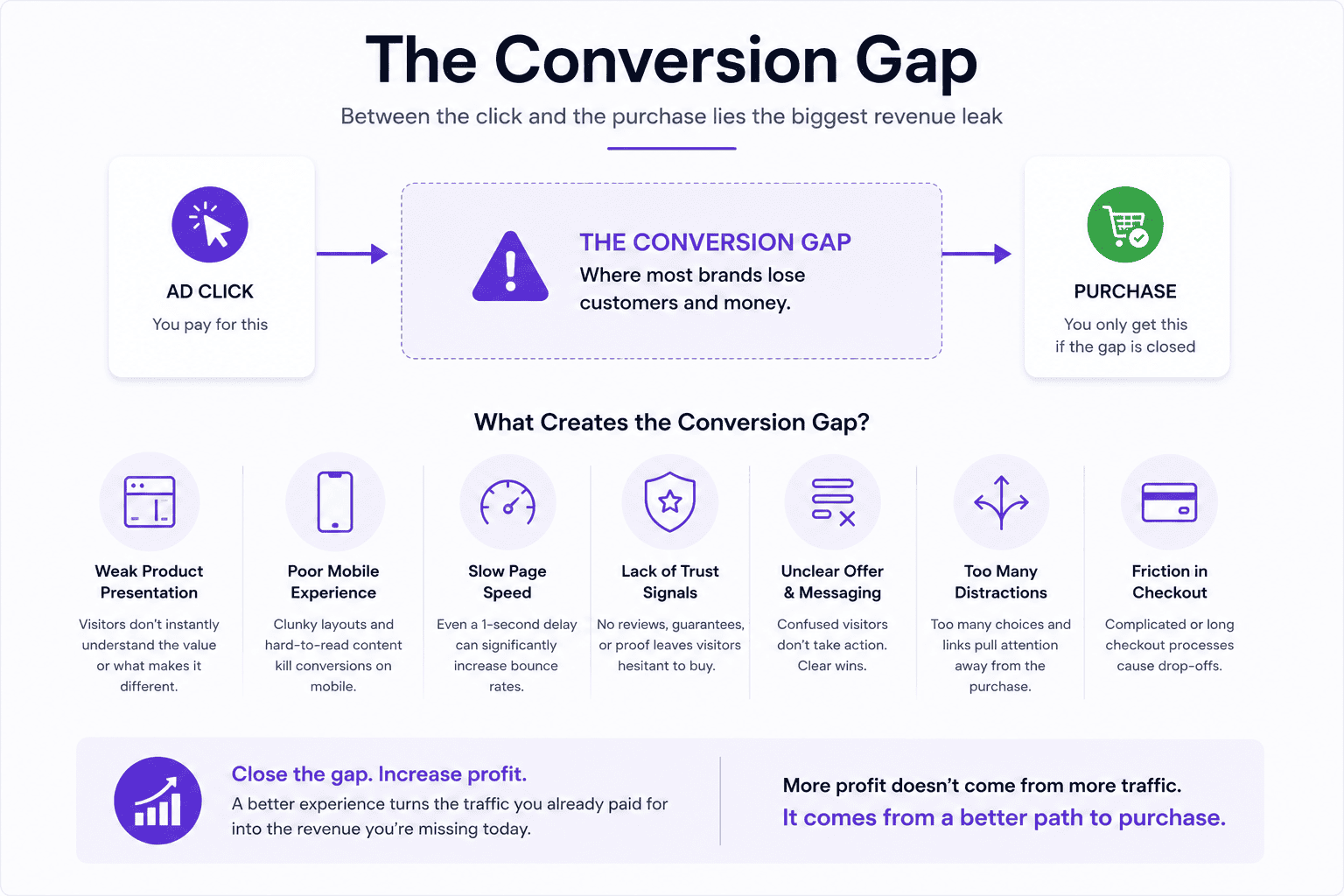
Between every click and every purchase exists a hidden battlefield. We call it the Conversion Gap. This is where revenue is won or lost.
The Conversion Gap appears in dozens of forms:
Unclear Product Positioning: Visitors arrive but cannot immediately understand why the product matters or why it is different from competing alternatives.
Generic Pages: The product may be excellent, but the experience looks identical to thousands of other stores using the same tired templates and layouts.
Slow Loading Speeds: This creates a major leak, particularly on mobile devices where customers expect instant experiences. Every additional second of friction increases abandonment.
Lack of Trust Signals: Visitors hesitate when pages lack reviews, guarantees, testimonials, user-generated content, or proof that the product delivers on its promise.
Poor Storytelling: Products are often presented as collections of features rather than solutions to real problems. Customers don't buy ingredients. They buy outcomes
Individually, each of these issues may seem small. Combined, they can destroy profitability.
Why Brands Like Grüns Convert Better
Consider brands like Grüns. Their success isn't simply the result of effective advertising. Thousands of ecommerce brands run ads every day, the difference lies in what happens after the click.
When visitors arrive on a Grüns page, they immediately understand the value proposition. The messaging is clear. The design guides attention. Social proof builds trust. Product benefits are explained before technical details are introduced.
Every section serves a purpose.
- The page educates.
- The page reassures.
- The page sells.
Rather than overwhelming visitors with navigation menus, categories, and distractions, the experience guides them toward a decision.
This is why two brands can buy the same traffic and achieve completely different outcomes. One creates a buying experience.The other simply displays a product.
AI Didn't Change Advertising. It Changed Store Creation.
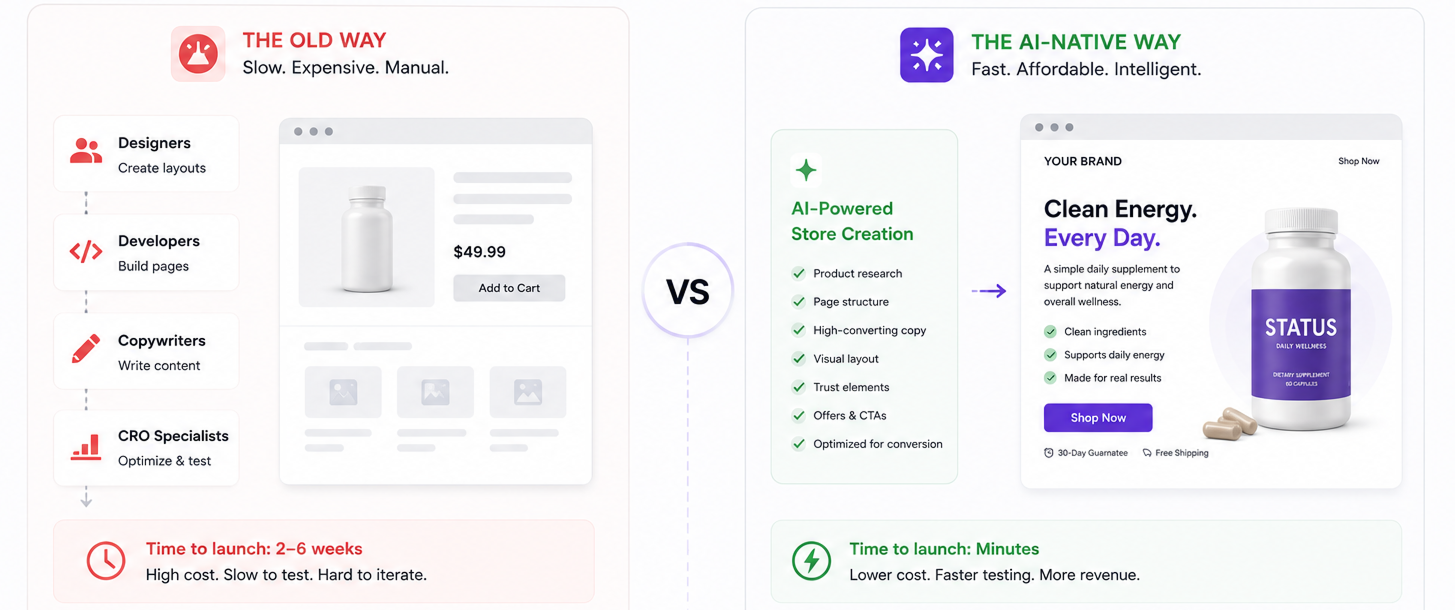
Historically, creating a high-converting ecommerce experience required designers, developers, copywriters, and conversion optimization specialists.Building pages took weeks,Testing new ideas was expensive ,Launching products was slow.
Most businesses simply accepted mediocre pages because improving them required too many resources. AI changes that equation completely.
Today, merchants can generate product descriptions, landing page structures, sales copy, visual layouts, and conversion-focused sections in minutes. This doesn't just improve efficiency ,It increases testing velocity.And in ecommerce, testing velocity often determines who wins.
- The businesses that launch faster learn faster.
- The businesses that learn faster scale faster.
Why AI-Native Platforms Have an Advantage
Most ecommerce platforms were built before AI became central to online selling.Store creation came first.Optimization came later.
AI was added as an extra feature, AI-native platforms reverse this philosophy.Instead of asking merchants to manually assemble stores, they focus on generating buying experiences optimized for conversion from day one.
- The objective is no longer simply building a store --> The objective is building a path to purchase.
That difference will define the next generation of ecommerce winners.
Why xPage Exists
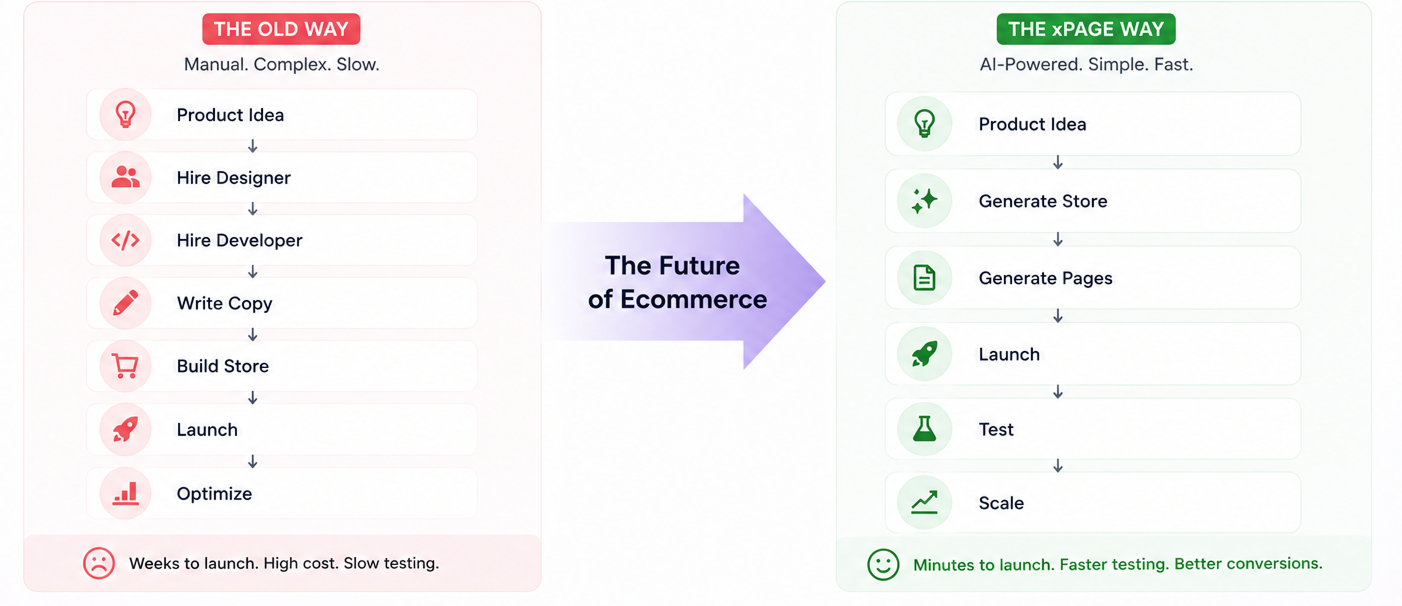
The internet doesn't need more stores.It needs better buying experiences.xPage was built around that reality.Not around themes. Not around plugins. Not around endless configuration. Around conversion. Around speed. Around helping merchants launch products and create experiences that turn visitors into customers.
Instead of spending weeks designing pages manually, merchants can generate conversion-focused product experiences, test offers faster, and launch products with significantly less friction.
Because at the end of the day, ecommerce success isn't determined by how many people visit your website.It's determined by how many decide to buy.
The Ecommerce Playbook Is Changing
For years, ecommerce operators believed growth came from buying more traffic:
- More ads.
- More creatives.
- More campaigns.
- More spend.
But the brands scaling fastest today understand something different.Traffic is no longer the competitive advantage anyone can buy traffic! The real advantage is what happens after the click:
Attention ➔ Trust ➔ Desire ➔ Action ➔ Revenue
The next generation of ecommerce winners won't necessarily have the largest advertising budgets. They'll have the best buying experiences. The best product stories.The best landing pages.The fastest testing cycles.The shortest path between discovery and purchase.
The question is no longer:How do I get more traffic?
The question is:What happens when that traffic arrives?
Because in modern ecommerce, growth isn't won in the ad account.It's won on the page.
Ready to Close the Conversion Gap?
Every day you spend optimizing ads while ignoring the customer experience after the click is another day of lost revenue.The brands winning in 2026 won't be the ones spending the most.
They'll be the ones converting the best.
Create high-converting landing pages, launch products faster, test more ideas, and turn more of your existing traffic into customers with xPage.
Build your brand, not your store.
What is the biggest reason ecommerce brands lose money on ads?
Most ecommerce brands lose money after the click due to weak landing pages, poor product storytelling, and low conversion rates rather than poor advertising.
What is the Conversion Gap?
The Conversion Gap is the difference between traffic acquisition and revenue generation. It measures how effectively a business converts visitors into customers.
Why are landing pages important for ecommerce?
Landing pages focus visitors on a single offer, reduce distractions, build trust, and improve conversion rates compared to generic storefronts.
How does AI help ecommerce businesses?
AI helps generate product pages, sales copy, layouts, and conversion-focused experiences faster, allowing businesses to launch and test products more efficiently.
What makes xPage different?
xPage is an AI-native ecommerce platform focused on helping merchants create conversion-focused product experiences, launch faster, and turn more traffic into customers.