
The Next Billion-Dollar Ecommerce Brands Will Be Built With AI
The Next Billion-Dollar Ecommerce Brands Will Be Built With AI
Introduction: The Biggest Shift Since Shopify
Shopify changed everything.
Before it, launching an online store meant hiring developers, designers, and project managers. It took months and cost thousands.
Shopify removed those barriers. Suddenly, anyone could start selling online.
That shift created a generation of independent brands that never would have existed otherwise.
Now something similar is happening again.
Artificial intelligence is changing not just how stores are built, but how entire ecommerce brands are launched, grown, and scaled.
The next billion-dollar ecommerce companies won't necessarily have larger teams or bigger budgets. They'll have better systems, faster execution, and AI embedded into every stage of the business.
We're entering a new era of AI ecommerce, where businesses are no longer limited by the size of their workforce or the complexity of their operations. Instead of assembling large teams to launch and manage an online business, founders can increasingly rely on intelligent systems that automate, optimize, and accelerate nearly every aspect of building a brand.
This isn't simply another productivity trend.
It's a structural shift in how ecommerce companies are created.
Just as cloud software transformed infrastructure and Shopify democratized online selling, AI is redefining what it means to build an ecommerce business in the first place.
The future of ecommerce won't belong to companies with the biggest teams.
It will belong to companies that move the fastest.
Why Building an Ecommerce Brand Used to Require a Team
For years, building a successful ecommerce business required assembling specialists across multiple disciplines.
Launching a single store often involved weeks or months of planning, coordination, revisions, and technical implementation.
A typical ecommerce brand needed:
- Developers to build and maintain the website
- Designers to create layouts and visual assets
- Copywriters for product pages and marketing content
- SEO specialists to improve visibility
- Paid advertising experts
- Email marketers
- Product managers
- CRO specialists
- Operations teams
- Customer support representatives
Even relatively small brands quickly accumulated significant overhead before generating meaningful revenue.
Every product launch became a project.
Every landing page required multiple approvals.
Every optimization depended on several different people working together.
As businesses grew, complexity grew alongside them.
Hiring became the default solution for increasing output.
More products meant more people.
More campaigns meant more meetings.
More growth meant more operational overhead.
Success wasn't just about having a great product.
It depended on coordinating dozens of moving parts efficiently.
For many entrepreneurs, this created a frustrating reality.
They spent more time managing workflows than building their brand.
Execution slowed.
Innovation slowed.
Growth slowed.
The opportunity cost became enormous.
AI Is Compressing Entire Teams Into One Workflow
Artificial intelligence fundamentally changes this equation.
Instead of replacing creativity, AI amplifies it.
Instead of replacing entrepreneurs, it removes repetitive work that once consumed entire departments.
Today, a founder can move from idea to live store dramatically faster than ever before.
Modern AI ecommerce platforms combine capabilities that previously required multiple software products and specialized teams.
Tasks that once took days can now happen in minutes.
Examples include:
- Generating product descriptions
- Writing SEO-friendly content
- Creating landing pages
- Producing marketing copy
- Structuring collections
- Building conversion-focused pages
- Personalizing customer experiences
- Optimizing content based on performance
- Launching products at scale
The result isn't simply faster execution.
It's an entirely different operating model.
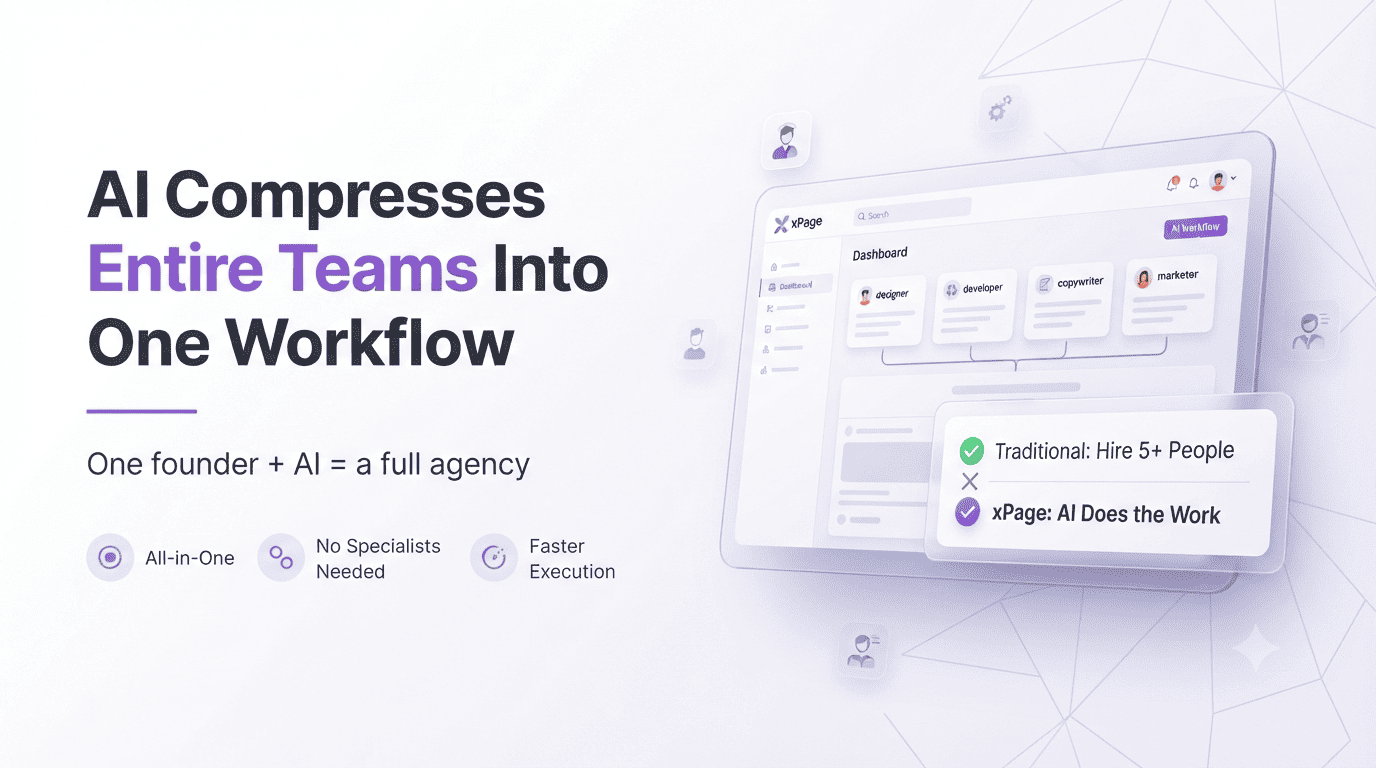
Instead of jumping between disconnected tools, entrepreneurs can work through one intelligent workflow where AI assists throughout the entire process.
This is especially transformative for startups and small businesses.
Rather than asking, "Who do we need to hire next?"
The question becomes:
"What can AI automate next?"
That shift dramatically lowers the cost of experimentation.
Founders can test ideas more frequently.
Launch products more often.
Iterate based on customer feedback.
And continuously improve without dramatically increasing operating expenses.
The companies that embrace AI ecommerce early won't just save time.
They'll build learning systems that compound over time.
The Competitive Advantage Is No Longer Size
For decades, enterprise brands held significant advantages.
They had:
- Larger budgets
- Bigger marketing teams
- More developers
- Better creative resources
- Dedicated analysts
- Specialized departments
Smaller businesses struggled to compete because execution depended heavily on available resources.
AI changes those economics.
Today, a lean team equipped with the right technology can produce output comparable to organizations many times its size.
The competitive advantage is shifting from organizational scale to execution speed.
Instead of asking how many employees a business has, a more relevant question is:
How quickly can it learn?
How quickly can it launch?
How quickly can it adapt?
Those capabilities increasingly determine market leadership.
The best founders are becoming orchestrators rather than operators.
Their job isn't to manually complete every task.
Their job is to guide intelligent systems that dramatically increase productivity.
This creates a new class of AI-native businesses.
Companies designed around automation from day one.
Companies where workflows are optimized before headcount expands.
Companies that prioritize speed, experimentation, and iteration over hierarchy.
In this environment, small teams become extraordinarily powerful.
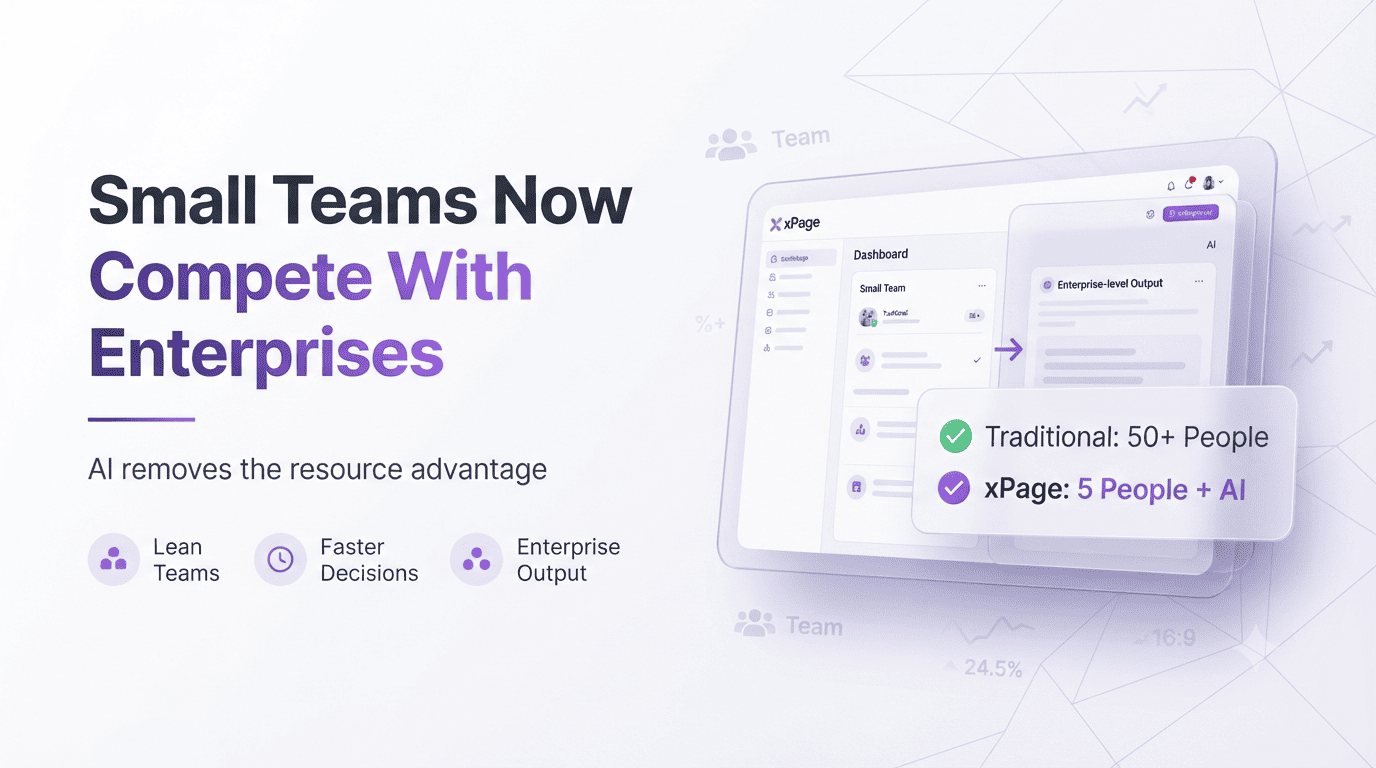
Five people can accomplish what once required fifty.
The gap between startups and enterprise organizations narrows considerably.
Execution becomes the true competitive advantage.
The Next Billion-Dollar Brands Will Be AI-Native
Every major technology shift creates new market leaders.
The internet created digital-first businesses.
Mobile created app-first companies.
Cloud computing created SaaS.
Shopify created direct-to-consumer brands.
AI will create AI-native ecommerce companies.
These businesses won't simply add AI features onto existing processes.
They'll build every workflow around intelligence from the beginning.
Product creation.
Store creation.
Marketing.
Content.
Optimization.
Customer engagement.
Everything becomes AI-assisted.
This distinction matters.
Businesses that merely "use AI" still operate according to traditional systems.
AI-native companies rethink the entire workflow.
Instead of asking how AI can improve existing operations, they ask how operations should be redesigned around AI entirely.
That mindset produces exponential advantages.
Faster launches.
Lower costs.
More experimentation.
Better customer experiences.
Continuous optimization.
The winners won't necessarily have the best products first.
They'll become the fastest learning organizations in ecommerce.
As AI capabilities continue improving, these advantages compound.
The organizations that begin building AI-native systems today will establish operational advantages that become increasingly difficult for slower competitors to replicate.
The future of ecommerce belongs to businesses that embrace intelligence as infrastructure—not merely as an add-on feature.
Why AI Changes Store Creation
One of the most significant transformations happening today involves how online stores themselves are created.
Historically, launching an ecommerce website involved selecting themes, customizing layouts, writing content, uploading products, optimizing SEO, configuring navigation, testing mobile responsiveness, and refining every page manually.
The process often took weeks.
Sometimes months.
An AI ecommerce website builder changes that experience fundamentally.
Instead of manually constructing every page, entrepreneurs can describe their brand, products, audience, and goals.
AI generates the foundation.
Layouts become intelligent.
Content becomes contextual.
Design becomes adaptive.
Optimization begins immediately instead of months later.
This doesn't eliminate creativity.
It gives creators more time to focus on high-value decisions.
Brand identity.
Product strategy.
Customer relationships.
Growth.
Rather than spending countless hours arranging page elements, founders spend more time creating differentiated brands.
Similarly, an AI store builder reduces technical friction throughout the launch process.
Instead of treating store creation as a technical project, it becomes a strategic conversation.
Entrepreneurs focus on building businesses rather than configuring software.
This represents one of the biggest shifts since ecommerce platforms first became mainstream.
Store creation becomes dramatically faster.
Product launches become dramatically simpler.
Iteration becomes continuous.
That speed compounds into long-term competitive advantage.
The Future Belongs to Builders, Not Operators
Traditional ecommerce rewarded operational excellence.
Success often depended on maintaining increasingly complex systems.
Managing software.
Managing agencies.
Managing employees.
Managing integrations.
Managing endless workflows.
The next generation of businesses will operate differently.
Builders will outperform operators.
Builders focus on:
- Creating products customers love
- Testing new ideas quickly
- Building memorable brands
- Developing communities
- Experimenting continuously
- Improving customer experiences
AI handles much of the operational complexity beneath the surface.
That allows founders to spend more time where human creativity matters most.
The most valuable entrepreneurs won't necessarily know every technical detail.
They'll know how to ask better questions.
How to make faster decisions.
How to combine human insight with machine intelligence.
As AI capabilities continue evolving, this gap between builders and operators will continue widening.
Operational efficiency becomes increasingly automated.
Strategic thinking becomes increasingly valuable.
The future of ecommerce will reward founders who embrace this shift early.
Why xPage Exists
Every major technological transition creates a need for new platforms.
Cloud computing required cloud-native software.
Mobile required mobile-first experiences.
AI requires AI-native infrastructure.
That's why xPage exists.
xPage was built around a simple idea:
Entrepreneurs should spend their time building brands—not assembling technology stacks.
Instead of forcing users through outdated workflows, xPage embraces intelligent automation throughout the ecommerce journey.
As an AI ecommerce platform, xPage is designed to help founders move from concept to launch with unprecedented speed.
Whether creating a new storefront, launching products, generating optimized content, or refining customer experiences, AI is integrated into the core workflow rather than added as an afterthought.
As an AI store builder, xPage helps eliminate repetitive setup work so businesses can focus on growth.
As an AI ecommerce website builder, it simplifies website creation while maintaining flexibility, performance, and scalability.
Most importantly, xPage reflects where ecommerce is heading—not where it has been.
The next generation of brands won't be built by larger organizations.
They'll be built by smarter systems supporting ambitious founders.
That's the philosophy behind xPage.
AI isn't replacing entrepreneurs.
It's giving them leverage.
And leverage changes everything.
Conclusion
Every transformative technology changes who gets to compete.
Shopify lowered the barriers to selling online.
AI is lowering the barriers to building world-class ecommerce brands.
The companies that thrive over the next decade won't simply adopt AI tools.
They'll become AI-native organizations from the very beginning.
They'll launch faster.
Experiment more frequently.
Operate with leaner teams.
Make smarter decisions.
And scale without the operational complexity that once slowed growth.
The emergence of AI ecommerce represents more than a new category of software.
It represents a new way of building businesses.
As AI ecommerce platforms continue evolving, founders will increasingly spend less time managing technology and more time creating exceptional customer experiences.
The AI store builder and AI ecommerce website builder are no longer niche innovations—they are becoming foundational tools for the next generation of digital commerce.
The future of ecommerce belongs to founders who combine human creativity with artificial intelligence to move faster than ever before.
The next billion-dollar ecommerce brands won't simply use AI.
They'll be built with it.
If you're building the next generation of ecommerce, don't just modernize your workflow—reimagine it from the ground up with AI at its core.
Because the future won't be defined by who has the biggest team.
It will be defined by who builds the smartest systems.
Build Your Brand, Not Your Store.