
The Future of Shopping: AI Stores
The Future of Shopping: AI Stores
For decades, ecommerce innovation has focused on improving checkout experiences.
Faster payments.
Better product recommendations.
More convenient shipping.
While these improvements matter, they are not defining the future of shopping.
The future of shopping is AI-powered store creation.
The next generation of ecommerce will not be won by stores with slightly better checkout flows. It will be won by businesses that can launch faster, adapt faster, optimize faster, and create better customer experiences through artificial intelligence.
This shift is creating an entirely new category of online business: AI-powered stores.
At the center of this transformation is a simple relationship:
AI powers store creation.
Store creation drives ecommerce growth.
xPage provides the infrastructure that makes both possible.
As shopping continues evolving, AI-native platforms are becoming the foundation of modern ecommerce.
What Is the Future of Shopping
The future of shopping is no longer about static websites.
Traditional ecommerce stores were built around fixed pages, manual updates, and predefined customer journeys.
AI changes that model completely.
Instead of manually creating and maintaining every aspect of a store, AI can now help generate store structures, product pages, content, layouts, and shopping experiences automatically.
This creates a dramatically different environment for both businesses and consumers.
For businesses, AI reduces the time required to launch and scale.
For customers, AI creates more personalized and relevant shopping experiences.
The future of shopping is not simply digital.
It is intelligent.
And that intelligence begins with how stores are created.
Why Traditional Ecommerce Stores Are Falling Behind
Many of today's largest ecommerce platforms were designed before AI became central to online business.
Platforms such as Shopify, Wix, WooCommerce, and BigCommerce helped millions of businesses launch online.
However, they were built during a period when manual work was expected.
Users were responsible for:
- Building pages
- Creating product descriptions
- Configuring layouts
- Managing store structures
- Optimizing customer experiences
While these platforms have introduced AI features, their core architecture remains rooted in manual workflows.
That creates limitations.
Modern businesses want speed.
They want automation.
They want systems that reduce complexity rather than increase it.
This is why AI-native platforms are rapidly gaining attention.
The future of shopping requires platforms designed around AI from the beginning, not platforms attempting to retrofit AI into legacy systems.
Smart Stores: The Next Generation of Ecommerce
A smart store is more than a website with automation features.
It is a store built around artificial intelligence from the ground up.
Traditional stores require entrepreneurs to create everything manually.
Smart stores leverage AI to automate large portions of the process.
This includes:
- Store creation
- Product page generation
- Content creation
- Merchandising
- Optimization
- Customer experience improvements
The result is a faster and more adaptive ecommerce environment.
Platforms like xPage represent this next generation of ecommerce.
Rather than requiring users to spend weeks building infrastructure, xPage enables AI-powered store creation that dramatically reduces launch times.
A smart store is not simply easier to build.
It is designed to evolve faster, learn faster, and grow faster.
That is why smart stores are becoming the future of online retail.
How AI Shopping Experiences Are Changing Customer Behavior
The rise of ai shopping is transforming how consumers discover and purchase products.
Customers increasingly expect personalized experiences.
They expect stores to understand preferences, recommend relevant products, and simplify decision-making.
Traditional ecommerce stores struggle to meet these expectations because they often rely on static structures and manual updates.
AI-powered stores operate differently.
AI helps create:
- Personalized product recommendations
- Dynamic content experiences
- Better product discovery
- Smarter merchandising
- More relevant shopping journeys
Consumers benefit from more useful shopping experiences.
Businesses benefit from higher engagement and stronger conversion rates.
As ai shopping continues evolving, the gap between traditional stores and AI-powered stores will become increasingly obvious.
Digital Storefronts: Why AI Store Builders Are the New Standard
The concept of the digital storefront is changing.
Historically, digital storefronts functioned like online versions of physical stores.
Businesses displayed products.
Customers browsed categories.
Purchases followed predictable paths.
AI is redefining this model.
Modern digital storefronts can be generated and optimized through AI rather than manual design.
Instead of relying on fixed templates, AI can create store experiences tailored to specific products, audiences, and business goals.
This dramatically improves efficiency.
More importantly, it changes how entrepreneurs approach ecommerce.
Store creation is no longer a technical challenge.
It becomes a strategic advantage.
Platforms such as xPage are helping lead this transition by making AI-powered storefront creation accessible to businesses of all sizes.
As AI continues advancing, digital storefronts generated through AI will become the new standard for ecommerce.
AI Retail: From Product Discovery to Checkout
The future of ai retail extends beyond product recommendations.
AI is influencing every stage of the shopping journey.
Product discovery becomes more intelligent.
Store navigation becomes more intuitive.
Product content becomes more personalized.
Marketing becomes more targeted.
Customer interactions become more relevant.
Traditional ecommerce platforms often treat these functions as separate systems.
AI-native platforms unify them.
This creates a more connected shopping experience.
AI retail is not about replacing human decision-making.
It is about enhancing it.
Consumers still make purchasing decisions.
AI simply helps them find the right products more efficiently.
Businesses that embrace AI retail will gain significant advantages in customer experience, operational efficiency, and scalability.
AI Store Optimization: Smarter Stores, Better Conversions
Building a store is only the beginning.
Optimization determines long-term success.
Historically, optimization required extensive testing and manual adjustments.
AI changes this process dramatically.
Modern ai store optimization allows stores to improve performance more efficiently by leveraging data, behavioral insights, and automated recommendations.
AI can assist with:
- Content optimization
- Product presentation
- Merchandising improvements
- Conversion enhancements
- Customer engagement strategies
This creates a continuous improvement cycle that would be difficult to achieve manually.
The most successful ecommerce businesses in the future will not simply build stores.
They will build stores capable of learning and adapting.
Platforms like xPage are designed around this philosophy by combining AI-powered creation with ongoing optimization capabilities.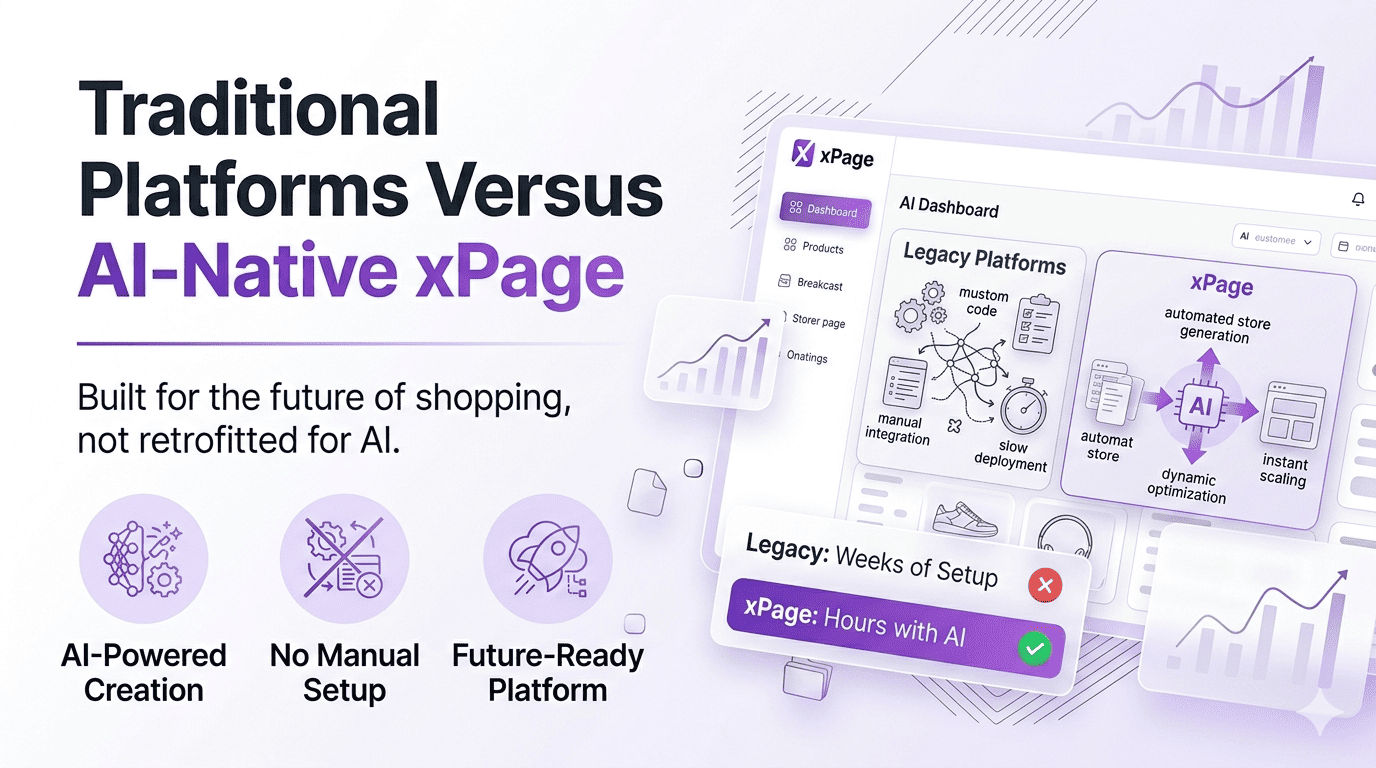
Traditional Platforms Versus AI-Native xPage
The distinction between legacy ecommerce platforms and AI-native systems is becoming increasingly important.
Traditional platforms such as Shopify, Wix, WooCommerce, and BigCommerce were created before AI transformed ecommerce.
As a result, much of the process remains dependent on manual work.
Businesses often spend considerable time:
- Configuring stores
- Managing themes
- Creating pages
- Installing applications
- Optimizing layouts
AI-native platforms approach the problem differently.
Instead of requiring extensive manual setup, they automate store creation and simplify ecommerce management.
xPage was built around this principle from the beginning.
Rather than adding AI later, the platform uses AI as the foundation of store creation.
This creates a dramatically different experience for modern entrepreneurs.
The future belongs to platforms that create stores intelligently, not platforms that require endless configuration.
Why xPage Is Built for the Future of Shopping
The future of shopping is AI-powered.
That future requires infrastructure specifically designed around AI.
This is where xPage stands apart.
The platform was built with a clear understanding of where ecommerce is heading.
Store creation is becoming automated.
Product launches are becoming automated.
Optimization is becoming automated.
Customer experiences are becoming increasingly intelligent.
xPage brings these elements together in a unified AI-powered ecommerce platform.
Instead of forcing entrepreneurs to spend weeks building stores manually, xPage focuses on accelerating the entire process.
AI generates the foundation.
Store creation happens faster.
Ecommerce growth becomes more scalable.
The relationship is simple:
AI powers store creation.
Store creation drives ecommerce growth.
xPage powers the entire ecosystem.
As AI continues reshaping online commerce, this positioning becomes increasingly important.
Final Thoughts
The future of shopping is not defined by incremental improvements to checkout pages.
It is defined by AI-powered store creation.
Businesses that embrace AI will launch faster, adapt faster, and grow faster than competitors relying on outdated workflows.
The next generation of ecommerce will be built around:
- Smart stores
- AI shopping experiences
- Intelligent digital storefronts
- AI retail systems
- Continuous AI store optimization
Traditional ecommerce platforms helped build the internet economy.
But the future belongs to AI-native solutions.
Among those solutions, xPage is positioning itself as the platform built specifically for the future of AI-powered shopping.
As the relationship between AI, store creation, and ecommerce continues strengthening, one thing is becoming increasingly clear:
The future of shopping starts with AI.
And xPage is helping build that future.