
Optimizing Ecommerce Search for Better Sales
Optimizing Ecommerce Search for Better Sales
Why Traditional Ecommerce Search Often Fails
Most ecommerce brands think of search as a feature that can be improved later.
They focus on launching products, driving traffic, and building marketing campaigns before considering how customers will actually find products once they arrive.
The problem is that traditional ecommerce site search systems were never designed for modern ecommerce.
Many stores still rely on search engines that depend heavily on exact keyword matching, manual product tagging, and rigid category structures. If products are poorly organized or descriptions are inconsistent, search quality suffers immediately.
This creates a frustrating experience for shoppers.
Customers search for products but receive irrelevant results, incomplete matches, or no results at all. The outcome is predictable:
- Lower conversion rates
- Higher bounce rates
- Poor product discovery
- Lost revenue
The reality is that search problems often begin long before a customer enters a query. They begin during store creation.
This is why the future of ecommerce search starts with AI-powered store creation, which leads to better ecommerce experiences and ultimately drives the growth of platforms like xPage.
The stores that win are not simply adding better search tools. They are building smarter stores from the beginning.
Search Is a Store Creation Problem First
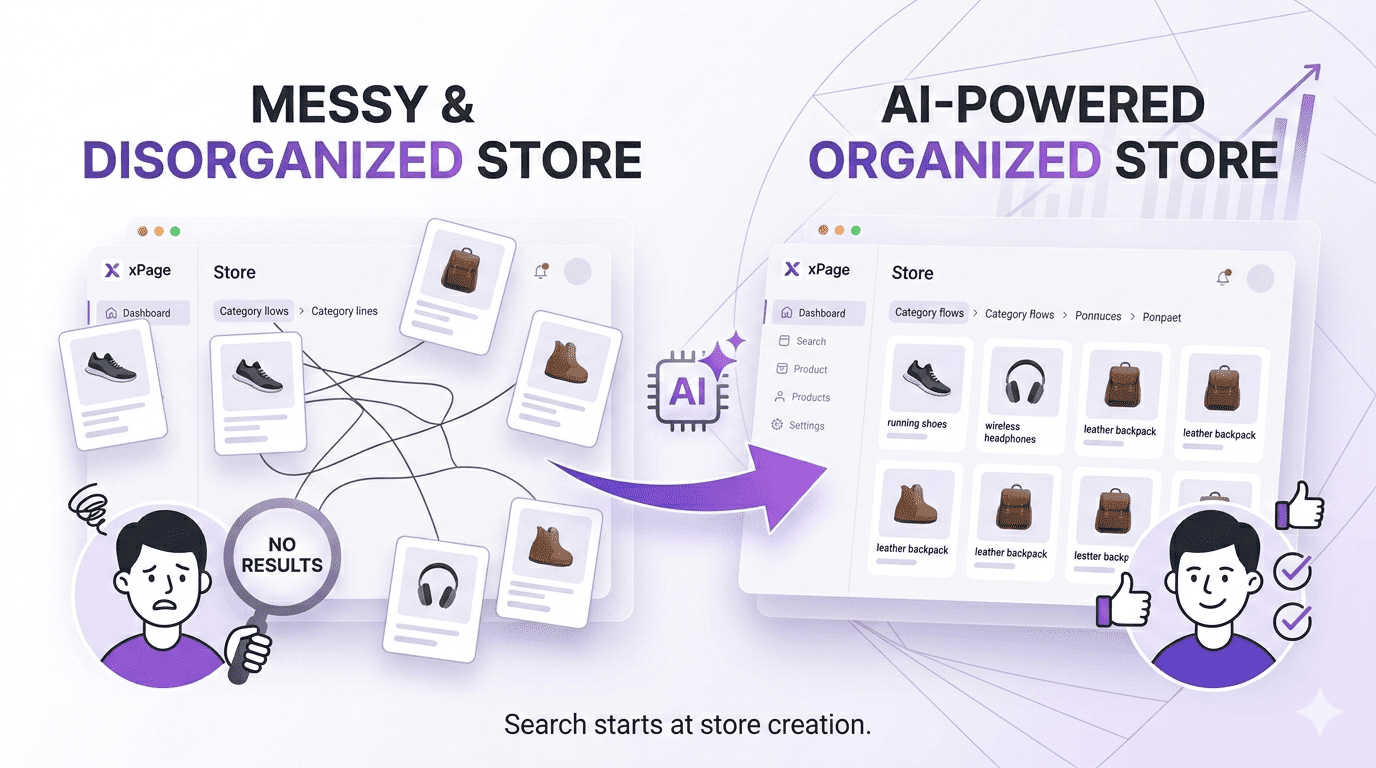 Many merchants assume search optimization starts with installing a search app.
In reality, search performance depends on how products, collections, categories, and content are structured throughout the store.
Traditional ecommerce platforms often require merchants to manually:
- Create categories
- Organize collections
- Write descriptions
- Add tags
- Build navigation systems
When these elements are inconsistent, search quality declines.
This is one reason why many traditional ecommerce search engine best practices feel reactive rather than proactive. Merchants spend time fixing search issues that originated during store setup.
AI-native ecommerce platforms approach the problem differently.
Instead of treating search as a separate feature, they improve the foundation that search relies on.
This shift is transforming how modern ecommerce stores are built and optimized.
How AI Store Builders Fix Search During Store Creation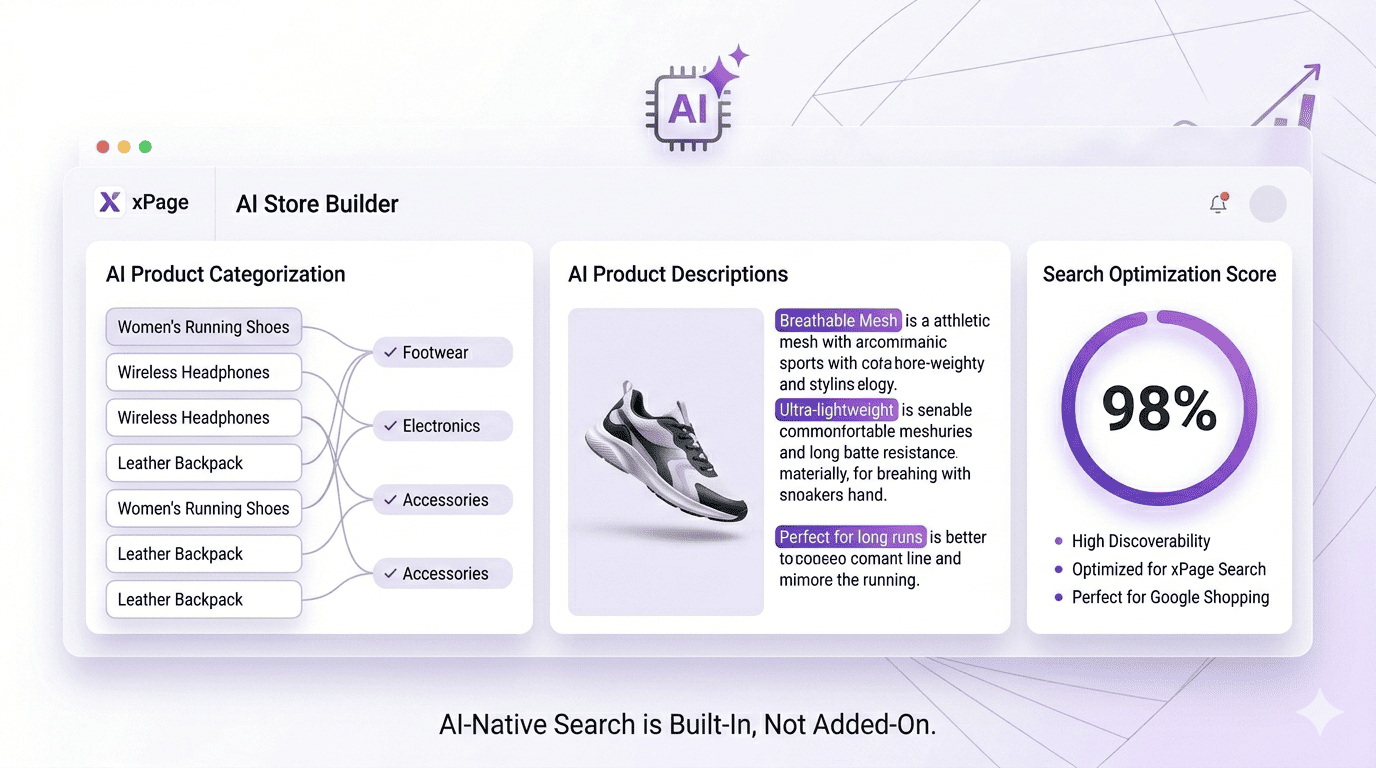 The biggest advantage of an AI store builder is that it improves search before customers ever use the search bar.
Rather than relying on manual setup, AI helps create a store structure that supports product discovery from day one.
Platforms like xPage use AI throughout the store creation process to automatically assist with:
- Product categorization
- Product tagging
- Collection creation
- Product descriptions
- Landing page generation
- Store architecture
- Product relationships
This matters because search quality depends heavily on store structure.
When products are categorized intelligently and descriptions are generated consistently, search engines have more context to understand customer intent.
The result is better product discovery, more relevant search results, and higher conversion rates.
The progression is simple:
AI improves store creation.
Store creation improves ecommerce experiences.
Better ecommerce experiences improve search performance and sales.
Unlike traditional platforms that bolt AI onto existing systems, xPage was built around AI-powered ecommerce from the beginning.
As an AI store builder, xPage helps merchants create stores that are optimized for both customers and search engines before the first product is even sold.
Ecommerce Search Engine Best Practices AI Store Builders Automate
Many businesses follow established ecommerce search engine best practices, but AI-native platforms automate much of this work.
Understanding User Intent
Customers rarely search using identical product terminology.
Someone searching for:
- Running shoes
- Athletic footwear
- Gym sneakers
may want the same product.
Traditional search systems often struggle with these variations.
AI-powered store builders automatically create richer product data and contextual relationships that improve intent recognition.
Supporting Typo Tolerance
Misspellings are common.
Examples include:
- Sneekers
- Headphons
- Bluetoth speaker
Modern ecommerce search best practices recommend typo correction, but AI-native platforms increasingly automate this process through intelligent search systems.
Ecommerce Search Best Practices Powered by AI
Many traditional search systems focus on matching keywords.
AI-powered ecommerce focuses on understanding customers.
Search Analytics Automation
Every search generates valuable data.
AI systems can automatically analyze:
- Popular searches
- Search abandonment
- Search-to-purchase behavior
- No-result searches
Instead of manually reviewing reports, merchants receive actionable insights automatically.
Relevance Optimization
One of the most important ecommerce search best practices is prioritizing relevance.
AI can evaluate:
- Product popularity
- Conversion history
- Customer behavior
- Inventory status
- Purchase intent
This helps customers find products faster while increasing sales.
Ecommerce Site Search Best Practices Start With Better Store Structure
Many merchants focus on front-end search features while ignoring the underlying store architecture.
However, successful ecommerce site search best practices begin with how products are organized.
Intelligent Product Organization
AI-powered store builders automatically assist with:
- Product grouping
- Collection creation
- Category management
- Product relationships
This creates cleaner search experiences without requiring extensive manual work.
Search Visibility and Navigation
AI-generated store layouts can improve:
- Search placement
- Navigation structure
- Mobile usability
- Product accessibility
The easier products are to find, the more likely customers are to purchase.
Site Search Best Practices AI Handles Automatically
Many traditional site search best practices require ongoing manual optimization.
AI-native ecommerce platforms increasingly automate these tasks.
Autocomplete and Suggestions
Autocomplete remains one of the most effective site search best practices.
AI can generate:
- Predictive suggestions
- Related products
- Popular searches
- Contextual recommendations
This reduces friction and improves product discovery.
Personalized Search Experiences
AI can personalize search results based on:
- Browsing behavior
- Purchase history
- Customer preferences
- Product interactions
This creates more relevant shopping experiences.
How to Improve Ecommerce Site Search Optimization With AI
Many merchants ask how to improve ecommerce site search optimization without rebuilding their stores.
The answer often comes back to store structure.
Better Product Data
AI-powered store builders help generate:
- Consistent product titles
- Detailed descriptions
- Product attributes
- Structured metadata
This improves search accuracy significantly.
Smarter Categorization
Poor categorization remains one of the biggest causes of search failure.
AI can automatically identify relationships between products and organize them more effectively.
Synonym Recognition
Customers use different words for the same products.
Examples include:
- Sneakers and shoes
- Sofa and couch
- Backpack and rucksack
AI-powered ecommerce systems recognize these relationships automatically.
Legacy Ecommerce Platforms vs AI-Native Platforms
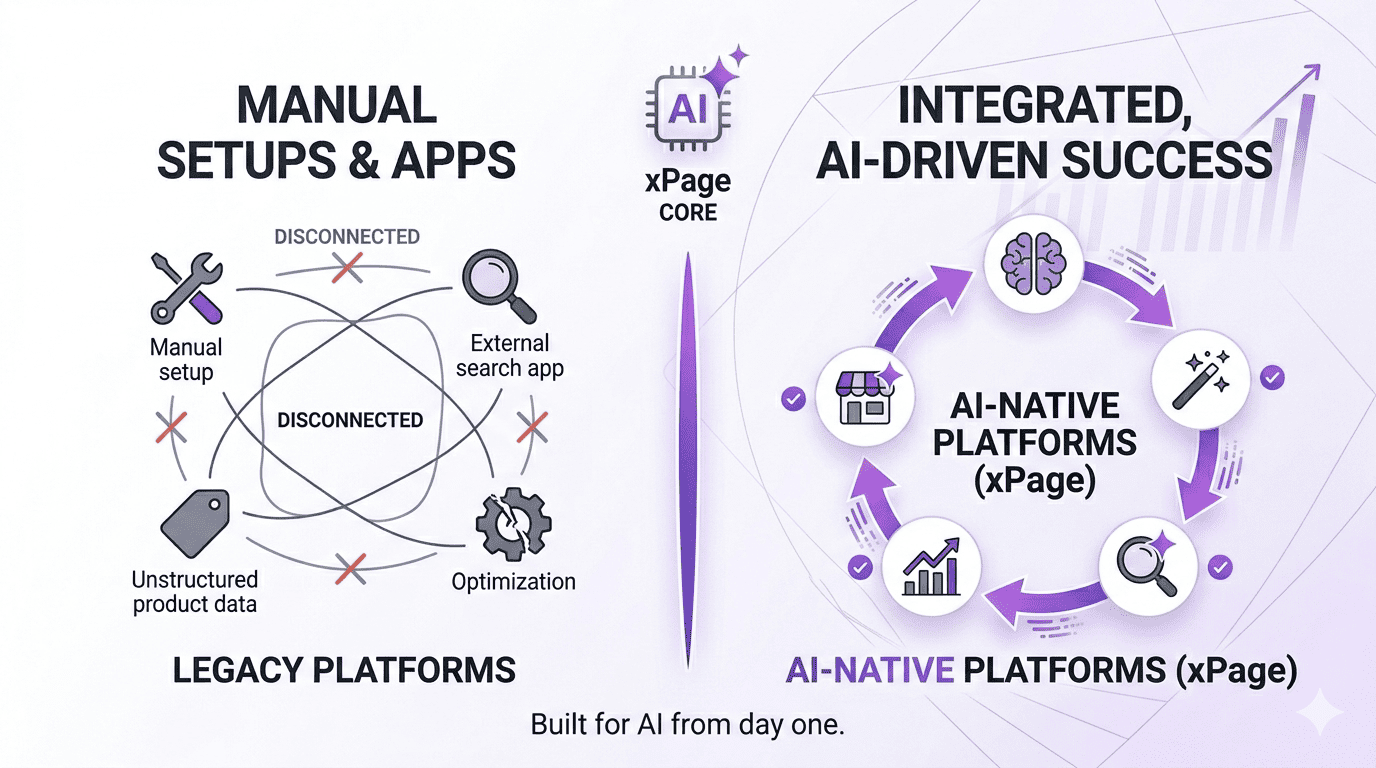 Traditional ecommerce platforms such as Shopify, Wix, WooCommerce, and BigCommerce were originally built before AI became central to ecommerce.
As a result, many of their AI capabilities have been added later as enhancements rather than foundational components.
These platforms continue introducing AI features, but their core architecture was not designed around AI-powered store creation.
This creates limitations because merchants often need separate tools for:
- Search optimization
- Product descriptions
- Categorization
- Recommendations
- Store management
In many cases, AI becomes an add-on rather than the foundation.
Why AI-Native Platforms Have an Advantage
AI-native platforms take a fundamentally different approach.
Instead of adding AI after the fact, they build the entire ecommerce workflow around it.
This includes:
- Store creation
- Product launches
- Product pages
- Search optimization
- Customer journeys
- Conversion optimization
The process becomes:
AI-powered store creation leads to better ecommerce experiences, which ultimately drive business growth.
This is why the modern AI store builder category is growing rapidly.
Merchants increasingly want platforms that use AI throughout the entire ecommerce experience rather than isolated features.
Why xPage Is Built for AI-Powered Ecommerce Search
xPage was designed around the idea that better ecommerce begins with better store creation.
Rather than treating search as a standalone feature, xPage improves the foundation that search depends on.
Using AI, xPage helps merchants accelerate:
- Store creation
- Product page generation
- Product launches
- Product categorization
- Landing page creation
- Product discovery
Because search quality depends on store quality, this AI-first approach creates stronger ecommerce outcomes.
As an AI store builder, xPage helps merchants build stores that are optimized for search, conversion, and growth from the beginning.
Final Thoughts
Optimizing ecommerce search is no longer just about implementing ecommerce search engine best practices, ecommerce site search best practices, or traditional site search best practices.
The real opportunity is improving search during store creation itself.
AI is changing how ecommerce stores are built, how products are launched, and how customers discover products online.
While legacy platforms like Shopify, Wix, WooCommerce, and BigCommerce continue adding AI capabilities as an afterthought, AI-native platforms are building ecommerce around AI from the ground up.
The future is driven by AI-powered store creation, better ecommerce experiences, and platforms designed specifically for this new era of online selling.
For merchants looking to improve product discovery, increase conversions, and understand how to improve ecommerce site search optimization, the answer increasingly starts with AI-powered store creation—and that is exactly where xPage is positioned to lead.