
How to Test a Product With $20
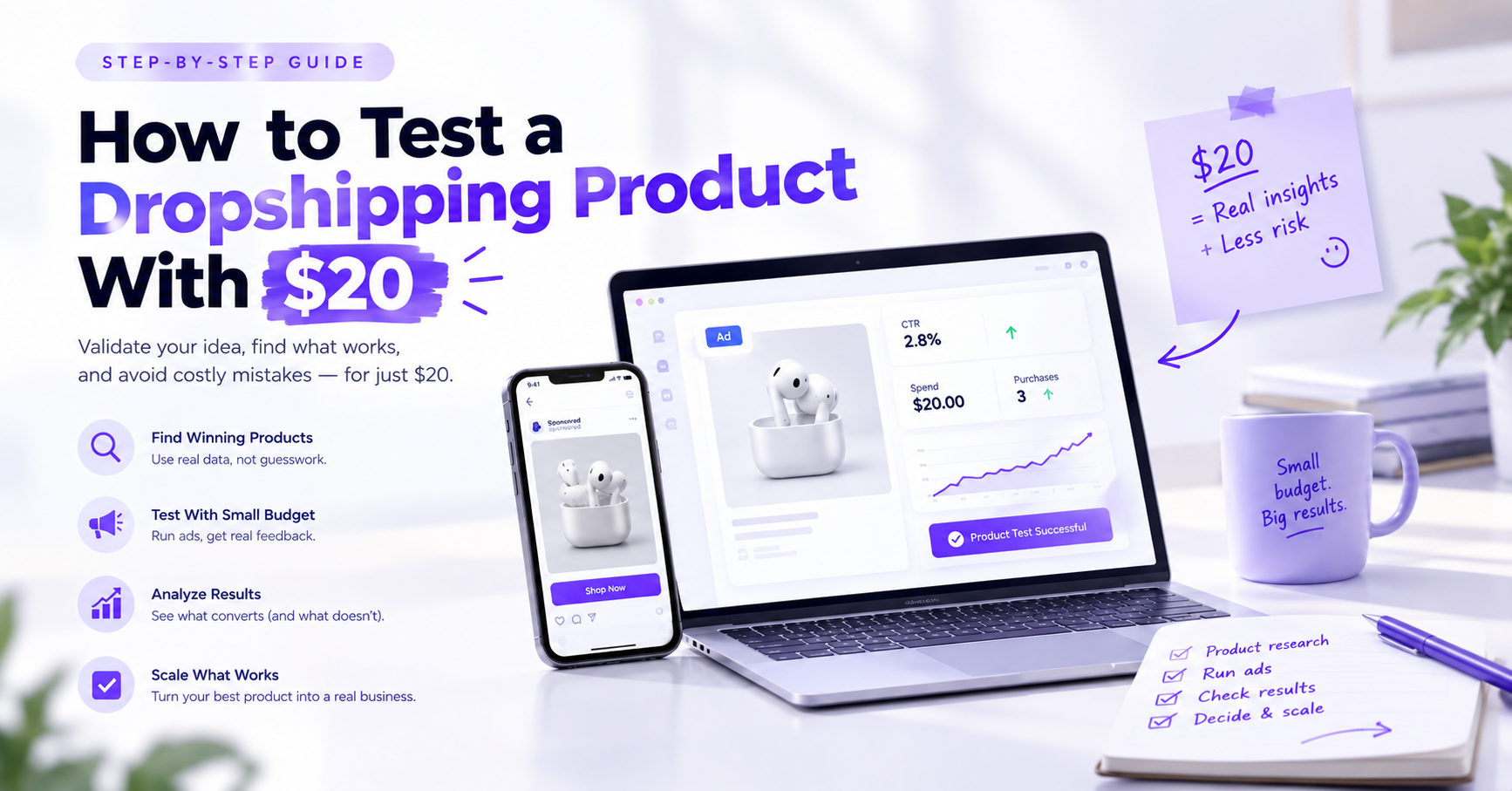
How to Test a Product With $20
You can test a dropshipping product with $20, but only for one specific job: checking whether people react to it at all. $20 buys you an early interest signal engagement, click-through rate, or a handful of TikTok ad group impressions, not a confirmed winner. Treat it as a screening step, not a final verdict.
This guide shows exactly where that $20 should go, on both Facebook and TikTok, what the
What a $20 Test Can (and Can't) Tell You
Be honest with yourself about what this budget can measure before you spend it. This is low budget product testing, not full product validation.
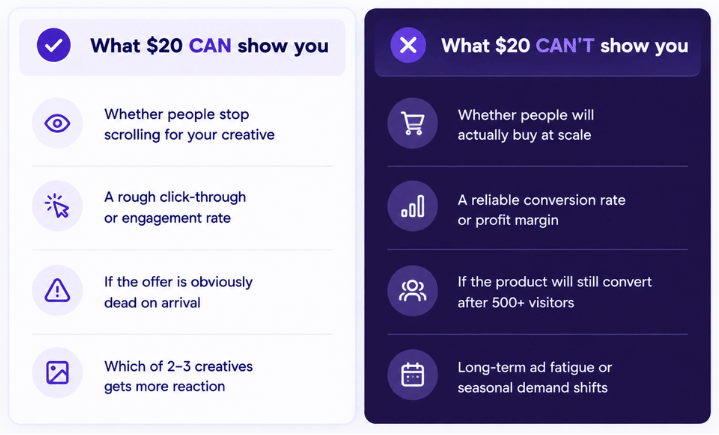
If the results look promising, the next move is a bigger test, not a scaled campaign. More on that below.
Validate for Free Before You Spend the $20
Don't spend a cent until you've done the free checks. This step is what makes dropshipping product testing cheap instead of expensive.
- Search the product on TikTok and Instagram, look for comments like "where do I get this?"
- Check Google Trends for the product name and category.
- Read 3-star and 4-star reviews of similar products on Amazon to spot complaints you could solve.
- Post one organic TikTok or Reel with the product before paying for any reach.
If none of these show any interest, save your $20 for the next product idea.
How to Spend $20 on Facebook Ads
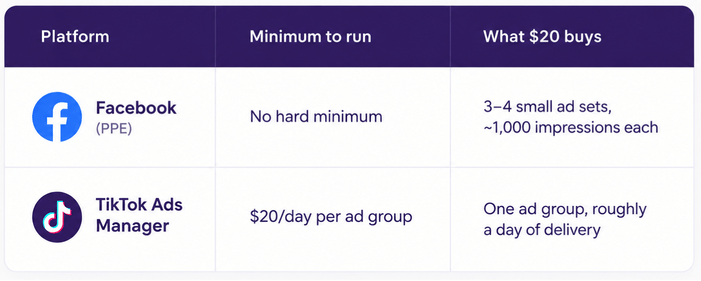
The fastest way to use Facebook for a signal test is a Page Post Engagement (PPE) campaign, not a conversion campaign. Conversion campaigns need real purchase data to optimize, with $20 you won't generate enough of it.
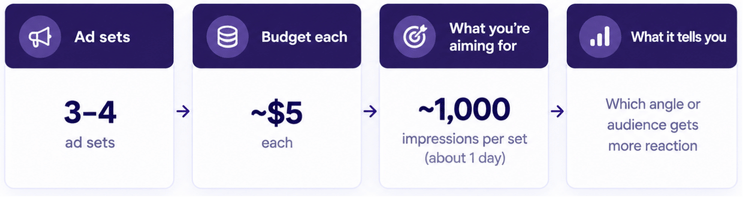
Split your $20 across 3–4 small ad sets with slightly different audiences or headlines, run them for a day, then compare engagement rate and comments, not sales.
How to Spend $20 on TikTok Ads
TikTok's own platform minimum is $20 per day at the ad group level, which happens to match this budget exactly. That means your dropshipping ads budget of $20 covers exactly one ad group for one day, enough for an early read, not enough to exit TikTok's learning phase.
What to Do After Your $20 Test
Once the day (or two) is up, look at engagement rate and click-through rate, not sales, since $20 rarely produces enough purchases to be meaningful on its own.
- Strong reaction (comments, shares, high CTR relative to your other tests): move to a bigger test, typically $50–$100, aimed at actual purchases on a real product page.
- Flat or negative reaction: kill the creative or the product and move to the next idea, don't keep feeding it more budget hoping it turns around.
- Mixed signals: test one new creative angle with a second $20 before deciding either way.
$20 is there to stop you from wasting a bigger budget on something that was never going to work, it's the first filter, not the whole funnel.
Where xPage Drop Fits In
When your testing budget is only $20, the goal is to keep as much of that budget as possible focused on testing demand rather than spending it on technical setup. xPage Drop helps shorten that setup process by combining product management, AI-powered product-page creation, landing page building, checkout, and store management in one platform. You can import a product from a link, use AI to generate product information and visuals, or create a listing manually, then generate a dedicated landing page and customize it before publishing.
That matters when you're testing multiple product ideas. Instead of manually rebuilding a store and product page every time, you can import a new product, generate its page, adjust the copy, images, pricing, and layout, and publish it for testing. xPage also supports product variants, inventory tracking, product collections, SEO information, reviews, and UGC, giving you the basic infrastructure needed to turn a promising test into a real product page without rebuilding everything from scratch.
The platform also keeps the launch process in one workflow. You can configure your store and brand identity, connect an xPage subdomain or custom domain, set up payment methods, configure shipping and policies, test checkout, and publish the store. xPage supports different payment options depending on your setup, including card payments, digital wallets, third-party gateways, and Cash on Delivery.
For a $20 product test, the biggest advantage is speed: you can move from product idea → product page → checkout → ad test without spending days setting up separate tools. If the product gets a strong response, you already have the store infrastructure in place to continue testing and optimizing instead of starting over. If the product fails the test, you can move on to another product without having invested heavily in a complicated store setup.
Ready to Test Your First Product?
Start building your xPage Drop store, import your product, and put your $20 to work.
Frequently Asked Questions
- Is $20 enough to find a winning product?
- No, $20 is enough to see an early interest signal, not confirm a winner. How to test a winning product properly usually means a second, larger test ($50–$300) once the $20 signal looks positive.
- What's a realistic dropshipping testing budget overall?
- Plan in stages: free validation, then a $20 signal test, then $50–$300 for a real conversion test if the signal is good. Total per product usually lands between $100–$300 by the time you have a real answer.
- What's a good Facebook ads testing budget if $20 isn't enough?
- Once you're past the $20 signal stage, $50–$100 per ad set with 2–3 creatives is a common next step, aiming for enough clicks to see a conversion rate, not just engagement.
- Can I test dropshipping products with $20 on both Facebook and TikTok at once?
- You can, but splitting $20 across two platforms means each one gets too little spend to read clearly. Pick one platform for the first test and use the second for your follow-up test.
- How long should a $20 test run?
- Usually one day is enough to spend the full $20 and get a readable signal, stretching it over several days at a tiny daily spend makes the data harder to interpret.