
How to Sell Online Without Stripe or PayPal
How to Sell Online Without Stripe or PayPal
For many entrepreneurs, launching an online business starts with a simple assumption:
Build a store.
List your products.
Connect Stripe or PayPal.
Start selling.
For years, those two payment providers have become almost synonymous with ecommerce. Most tutorials, ecommerce platforms, and online communities recommend connecting one—or both—as the default way to accept payments.
But what happens when you can't use either?
For thousands of entrepreneurs around the world, that's a daily reality.
Some live in countries where Stripe isn't supported. Others face limitations with PayPal, including account reviews, payout delays, or operational restrictions. Some businesses simply want more flexibility and prefer not to build their entire operation around a single payment provider.
The result is frustration.
Not because they lack products.
Not because they lack customers.
But because the infrastructure needed to collect payments and run an ecommerce business isn't always accessible.
Many entrepreneurs begin searching for ways to sell online without Stripe or operate dropshipping without PayPal.
Most of the advice they find focuses on replacing one payment gateway with another.
While alternative payment providers can certainly help, they're only part of the solution.
Running a successful ecommerce business requires much more than processing payments.
It requires connected infrastructure.
That's where xPage Drop takes a different approach.
Instead of acting as another payment gateway, xPage Drop provides the complete operational foundation merchants need to launch, accept payments, manage orders, coordinate fulfillment, and grow—without depending on Stripe or PayPal.
1. Introduction: Why Stripe and PayPal Aren't the Only Options
Stripe and PayPal have played an important role in the growth of ecommerce.
They've helped millions of businesses accept payments online and simplify digital commerce.
For many merchants, they're excellent solutions.
However, they're not the only solutions.
Modern ecommerce has become increasingly global.
Entrepreneurs launch businesses from every corner of the world.
Customers shop across borders.
Businesses work with international suppliers.
As ecommerce expands globally, relying on one or two payment providers doesn't always meet the needs of every entrepreneur.
This is especially true for dropshipping businesses that often require flexibility, international accessibility, and streamlined operations.
If you're researching how to sell online without Stripe, you're not alone.
Many successful businesses operate using alternative payment and operational solutions designed for their specific markets and business models.
The important question isn't:
"Which payment provider should I replace Stripe or PayPal with?"
It's:
"What infrastructure does my business actually need to succeed?"
2. The Problem with Stripe and PayPal
Stripe and PayPal remain among the most widely recognized names in online payments.
But every payment platform comes with operational considerations that entrepreneurs should understand before building their businesses around a single provider.
Unsupported Countries
Not every entrepreneur can access every payment platform.
Stripe currently operates in selected markets, while PayPal availability and features also vary depending on the country.
For businesses outside supported regions, simply opening an account may not be possible.
Account Reviews and Temporary Restrictions
Like many financial service providers, Stripe and PayPal use automated systems and review processes to manage risk and comply with regulatory requirements.
During these reviews, merchants may experience temporary limitations while additional information is requested.
For businesses that rely heavily on uninterrupted payment processing, these interruptions can create operational challenges.
Payout Timing
Cash flow is critical in ecommerce.
Especially in dropshipping, merchants often depend on timely access to funds to pay suppliers, purchase inventory, and finance advertising campaigns.
Predictable settlement schedules help businesses operate more efficiently.
Chargeback Management
Chargebacks are part of online commerce regardless of the payment provider used.
Managing disputes effectively requires clear operational processes, customer communication, and reliable order tracking.
Strong infrastructure helps businesses respond more efficiently when these situations occur.
The common thread isn't that one provider is inherently "bad."
It's that building an entire business around a single payment processor can create unnecessary dependence.
3. What Dropshippers Actually Need
Many entrepreneurs begin by looking for another payment processor.
But payment collection represents only one part of operating a successful ecommerce business.
What dropshippers actually need is a complete system that supports every stage of selling.
That includes:
Reliable Payment Processing
Customers expect fast, secure checkout experiences regardless of which payment provider operates behind the scenes.
Global Accessibility
Businesses benefit from solutions that support merchants across a wide range of regions and markets.
A strong global payment solution for ecommerce helps reduce geographic barriers while enabling long-term growth.
Operational Stability
Merchants need dependable workflows that keep business moving smoothly from checkout through fulfillment.
Order Management
Every sale creates operational work.
Orders must be tracked, organized, and prepared for fulfillment efficiently.
Profit Settlement
Receiving earnings consistently is just as important as collecting customer payments.
Businesses need visibility into how revenue flows through their operations.
Together, these capabilities form a complete online payment solution for dropshippers—one that extends beyond checkout into the operational backbone of the business.
4. Why Alternatives Aren't Enough
When merchants discover they can't use Stripe or PayPal, they often search for replacement payment gateways.
Alternative providers certainly play an important role.
However, replacing one checkout system with another doesn't solve the broader operational challenge.
A payment gateway answers one question:
"How does the customer pay?"
Running an ecommerce business requires many more answers.
For example:
- How are orders managed?
- How are suppliers coordinated?
- How is fulfillment tracked?
- How are profits settled?
- How does the entire workflow stay organized?
Without connected systems, merchants often end up managing several different platforms simultaneously.
One solution handles payments.
Another manages orders.
Another coordinates fulfillment.
Additional software supports reporting and operations.
The result is unnecessary complexity.
Businesses don't simply need another gateway.
They need infrastructure.
That's the difference between solving one operational problem and solving the entire selling workflow.
5. Introducing xPage Drop
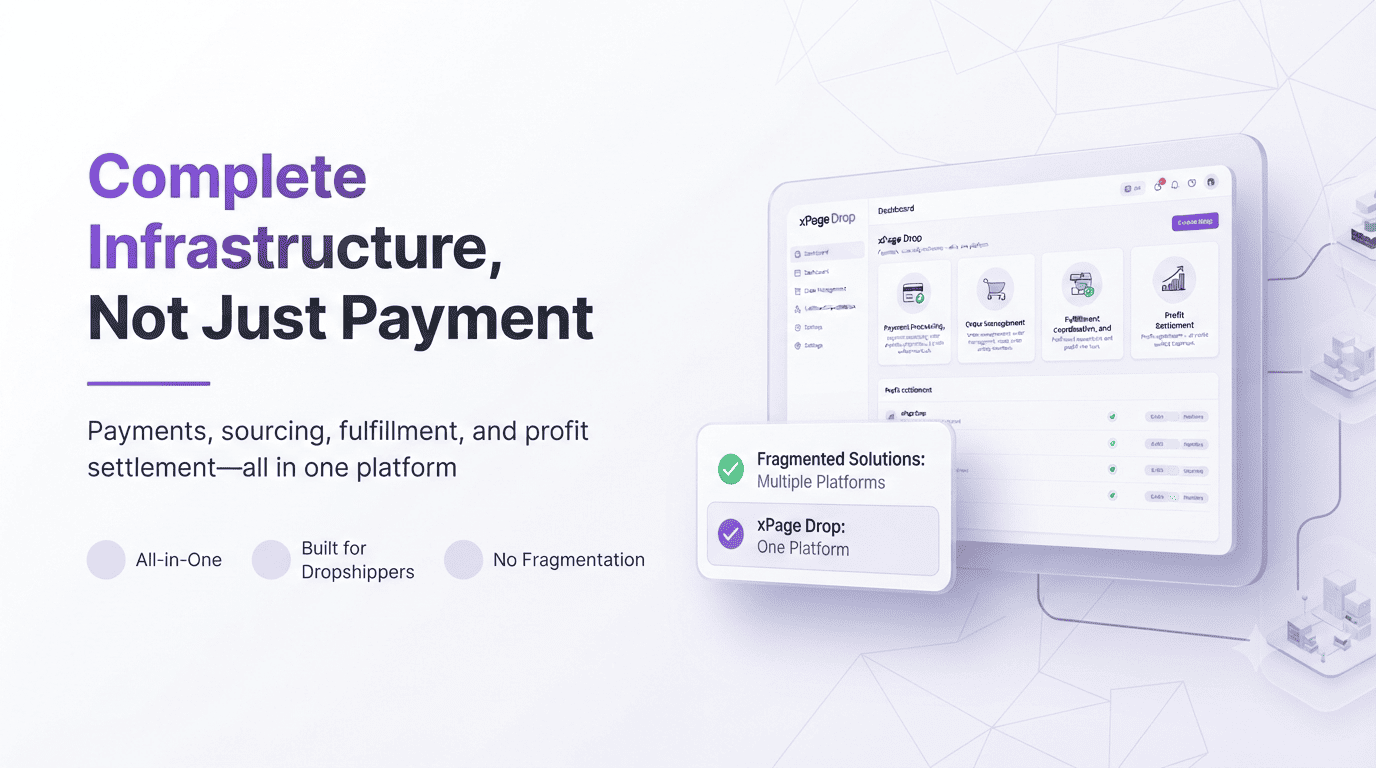
xPage Drop was designed around a different philosophy.
Instead of building another payment gateway, it provides a complete operational infrastructure for modern dropshipping businesses.
Its purpose is straightforward:
Help entrepreneurs launch, sell, fulfill, and grow without relying exclusively on Stripe or PayPal.
xPage Drop combines multiple business functions into one connected platform.
Merchants can:
- Accept customer payments
- Manage orders
- Coordinate fulfillment
- Track operational workflows
- Receive profit settlements
- Scale more efficiently
Rather than assembling multiple disconnected services, entrepreneurs gain access to one integrated system designed specifically for ecommerce operations.
This allows founders to spend less time managing software and more time building their businesses.
For merchants exploring dropshipping without PayPal or looking to sell online without Stripe, that's a meaningful advantage.
6. How xPage Drop Works
Getting started with xPage Drop is designed to be straightforward.
Instead of building a complicated stack of separate tools, entrepreneurs follow one connected workflow.
Step 1: Launch Your Store
Create your storefront and prepare your products for customers.
Focus on branding, product selection, and customer experience.
Step 2: Accept Customer Payments
Customers complete purchases through the platform without requiring merchants to depend exclusively on Stripe or PayPal.
Step 3: Manage Orders
Orders flow into a centralized operational workflow where they can be monitored and managed efficiently.
Step 4: Coordinate Fulfillment
Prepare and fulfill customer purchases using streamlined operational processes.
Step 5: Receive Your Profits
Track settlements and business performance while managing growth from one connected platform.
Instead of juggling multiple systems, merchants operate through a unified infrastructure built for ecommerce.
7. Comparison: xPage Drop vs. Stripe, PayPal, and Other Alternatives
Choosing a payment solution involves much more than comparing checkout experiences.
Here's the practical difference:
- Accept customer payments: xPage Drop supports payment collection while integrating it into a broader operational workflow. Stripe, PayPal, and many alternatives primarily focus on payment processing.
- Designed for dropshipping: xPage Drop is purpose-built around ecommerce operations, while many payment providers serve a broad range of industries.
- Order management: xPage Drop includes connected order workflows. Traditional payment providers generally require separate operational software.
- Fulfillment coordination: xPage Drop supports operational processes beyond checkout, reducing reliance on disconnected tools.
- Profit settlement: xPage Drop integrates settlement into the overall business workflow.
- Complete selling infrastructure: xPage Drop combines payments with operational capabilities, while most alternatives concentrate primarily on transaction processing.
The key distinction is simple.
Payment gateways process transactions.
Business infrastructure powers companies.
8. FAQ: Common Questions About Selling Without Stripe or PayPal
Can I sell online without Stripe?
Yes. Many businesses successfully sell online without Stripe by using alternative payment and operational solutions that fit their market and business requirements.
Can I run dropshipping without PayPal?
Absolutely.
Many entrepreneurs operate dropshipping without PayPal by choosing payment systems that better align with their region, customers, and operational needs.
How do I sell online without Stripe?
The process begins by choosing a platform that enables payment collection while also supporting order management, fulfillment, and business operations.
What should I look for in an online payment solution for dropshippers?
Look beyond payment processing.
Reliable operational workflows, efficient order management, transparent settlements, and scalable infrastructure are equally important.
What makes a good global payment solution for ecommerce?
Strong solutions support merchants across multiple regions while integrating smoothly into broader ecommerce operations.
Accessibility, reliability, and operational efficiency all matter.
Why isn't another payment gateway enough?
Because collecting payments is only one part of running a business.
Entrepreneurs also need systems that help them manage everything that happens after checkout.
9. Conclusion: Start Selling with xPage Drop
Stripe and PayPal remain important parts of the ecommerce ecosystem.
But they aren't the only path to building a successful online business.
For entrepreneurs facing regional limitations, operational complexity, or the desire for a more integrated approach, replacing one payment gateway with another only solves part of the problem.
The real solution is infrastructure.
Businesses need connected systems that support payments, order management, fulfillment, operational visibility, and long-term growth from one unified platform.
That's exactly what xPage Drop delivers.
Rather than functioning as another checkout provider, xPage Drop provides the complete infrastructure modern dropshippers need to launch confidently and scale efficiently.
Ready to Start Selling Today?
If you're looking for a better way to sell online without Stripe or build a business without depending on PayPal, it's time to think beyond payment gateways.
With xPage Drop, you gain an integrated platform that helps you accept payments, manage operations, fulfill orders, and grow your ecommerce business through one connected workflow.
Because successful dropshipping isn't built on checkout alone.
It's built on infrastructure.
Start selling today with xPage Drop.