
How to Find Low Competition Dropshipping Products
How to Find Low Competition Dropshipping Products
To find low competition dropshipping products, don't start with a list of products someone else says are "winning." Start with a product idea, verify that people actually want it, then measure how many businesses are actively selling and advertising it in your target market.
A useful starting rule is to look for products with fewer than five clearly identifiable direct competitors. But treat that number as a research threshold, not a guarantee. A product with zero competitors can mean an opportunity, or simply that there is little demand.
Your goal is to find the combination of real demand, limited direct competition, workable margins, reliable fulfillment, and a clear marketing angle.
The rest of this guide shows how to do that in six steps, what to check before spending on ads, and how to test a product without committing a large budget.
What "Less Than 5 Competitors" Actually Means
"Under 5 competitors" is a practical research rule, not an official definition of low competition.
Different tools and researchers measure competition differently. Some count all sellers worldwide, while others focus on advertisers, stores, marketplaces, or specific countries.
For a useful product test, define your own competitor count.
A direct competitor is a business that:
- Sells the same or substantially identical product.
- Targets the same customer problem or use case.
- Appears to be actively marketing or selling to your target market.
- Can realistically compete for the same customer.
This is more useful than simply counting every website where the product exists.
For example, a marketplace listing can confirm that a product already has demand, but it does not necessarily mean that the seller is competing for the same advertising audience as your store.
Google Shopping is useful for discovering retailers and checking how widely a product is offered, but its results are influenced by relevance, product information, personalization, and other ranking factors.
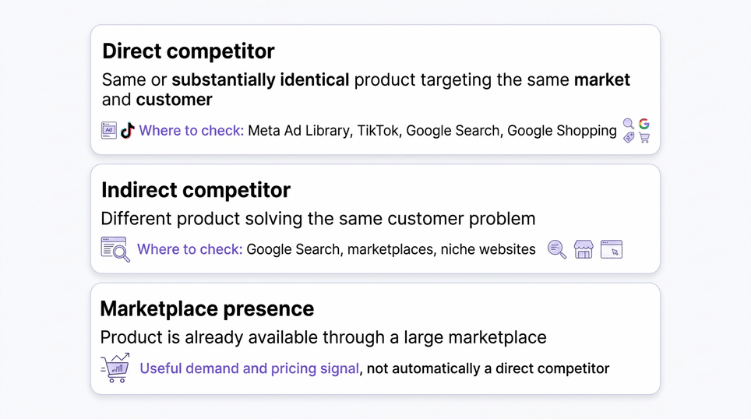
The important point is that competition should be measured against the market you actually plan to enter, not against every seller on the internet.
Step 1: Build a List of Ideas Away From the Obvious Feeds
If you only scroll popular product lists, you are likely to discover the same products other sellers are already researching.
Better dropshipping product research starts with multiple sources.
Look at:
- Supplier catalogs
- TikTok comments and product-related discussions
- Customer questions
- Product reviews and complaints
- Reddit discussions
- Niche communities and forums
- Seasonal events and buying periods
- Pinterest search and shopping trends
- Products appearing repeatedly in social content
The key is to start with a customer problem, not just a product.
Starting with the problem gives you more ways to discover products and marketing angles that other sellers may have overlooked.
That is particularly useful when looking for untapped dropshipping products rather than copying products already dominating popular feeds.
Step 2: Check Demand Before You Count Competitors
Low competition only matters if there is enough demand to support another seller.
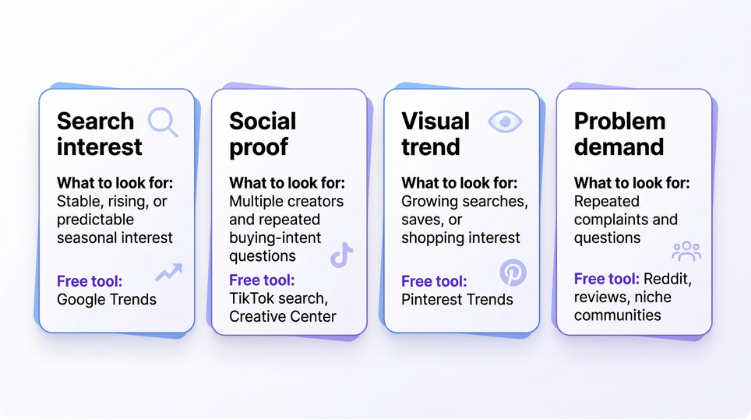
Start by checking whether interest exists and whether it is stable, growing, seasonal, or declining.
Use Google Trends for direction, not exact search volume
Google Trends does not tell you that a keyword receives a specific number of monthly searches. Its data is normalized on a 0–100 scale based on the relative popularity of a search term within the selected location and time period.
That means you should use it to answer questions such as:
- Is interest increasing?
- Is the product seasonal?
- Was the recent spike unusual?
- Is interest stable over a longer period?
- How does this product compare with related searches?
A useful starting point is to examine the last 12 months and then expand to several years when the product has enough historical data. Google Trends also provides comparison features that help you compare recent interest against previous periods.
Look beyond search volume
Social platforms can provide additional evidence.
On TikTok, look for:
- Multiple creators discussing the product.
- Repeated product-related questions.
- People asking where to buy it.
- Content appearing from different creators rather than one viral account.
- Continued interest rather than one isolated spike.
TikTok's Creative Center is a free resource that includes trends, Top Ads, keywords and products that can help with product and creative research.
Pinterest can also be useful for visual and shopping-oriented categories. Pinterest Trends provides historical data of up to two years across search, saves and shopping trends, with regional data and shopping-category insights.
The important distinction is that none of these signals proves that a product will sell. They help establish whether there is enough evidence to investigate the product further.
Step 3: Count Your Competitors the Right Way
This is the core of the process.
Instead of searching once and assuming the number of results equals competition, use several sources and record the distinct businesses you find.
Google Search and Google Shopping
Search the exact product name along with variations describing the problem it solves.
Look for independent stores and brands selling the same product.
Do not simply count every result. Google Shopping can contain products from many types of merchants, and ranking depends on relevance and other factors.
Use this step primarily to answer:
How widely is this product already being sold?
It is not a perfect measurement of the number of businesses competing in your advertising market.
Meta Ad Library
The Meta Ad Library allows you to search ads and select a country. Meta's documentation also supports filtering by active status and delivery dates.
For product research, search the product name and related problem.
Then record:
- Advertiser/business name
- Country
- Whether the ad is active
- Creative angle
- Offer
- Approximate launch date when available
The goal is to identify distinct advertisers, not count every creative variation as a separate competitor.
The Ad Library also has an important limitation: seeing an active ad does not tell you exactly how much the advertiser is spending or how profitable the campaign is.
TikTok
Search both:
- The product name.
- The customer problem.
Again, count distinct businesses or advertisers, not individual videos.
TikTok's Creative Center provides Top Ads that can be filtered by factors including region, industry, campaign objective and time frame, making it useful for understanding which advertising approaches are appearing in a particular market.
How to interpret the numbers
Instead of treating competitor counts as universal industry rules, use them as a practical research framework:
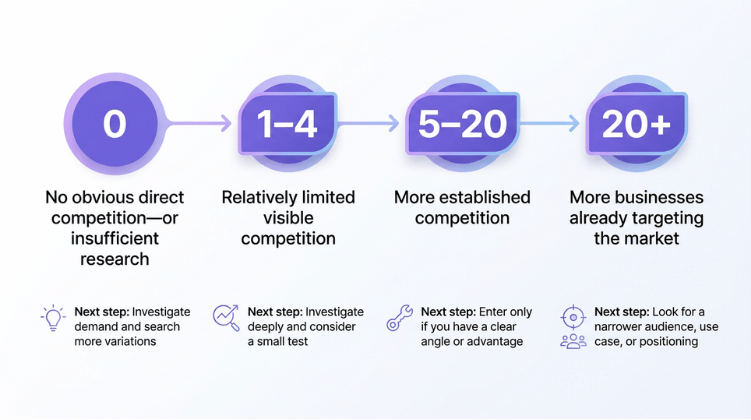
These are research thresholds, not industry standards.
The quality of the competitors matters as much as the quantity. Four established brands with strong offers can represent more meaningful competition than ten weak stores.
Step 4: Ask Why Nobody Is Selling It
When you find a product with little visible competition, do not immediately assume you found an untapped winner.
Ask:
Why is competition low?
There are several possible explanations.
The product may have low demand
This is the most important possibility to rule out.
If people are not searching for the product, discussing it, or showing buying intent, low competition may simply reflect low customer interest.
The product may be difficult to source
Some products look attractive until you investigate supplier availability, minimum order requirements, product quality, or consistency.
Shipping may be difficult
Bulky, fragile, heavy, or unusually shaped products can create expensive shipping and higher return risk.
Advertising may be difficult
A product may solve a real problem but be difficult to demonstrate visually or communicate quickly in an advertisement.
There may be compliance restrictions
Some categories have advertising, product-safety, regulatory, or platform restrictions. Always check the requirements that apply to your target country and product category.
There is also a positive version of this research.
Look at existing sellers and ask:
- Are their product pages weak?
- Are their images outdated?
- Is their offer unclear?
- Is the product poorly explained?
- Are shipping details confusing?
- Are there obvious customer complaints?
- Is there a specific audience they are ignoring?
That is where unsaturated dropshipping products can become interesting: not because nobody sells them, but because existing sellers may leave room for better positioning or execution.
Step 5: Run the Margin Math
Competition is only one part of product viability.
A product can have almost no competition and still fail because the economics do not work.
Before testing, calculate:
Selling price − product cost − shipping − transaction/handling costs − advertising cost = estimated contribution
For example:
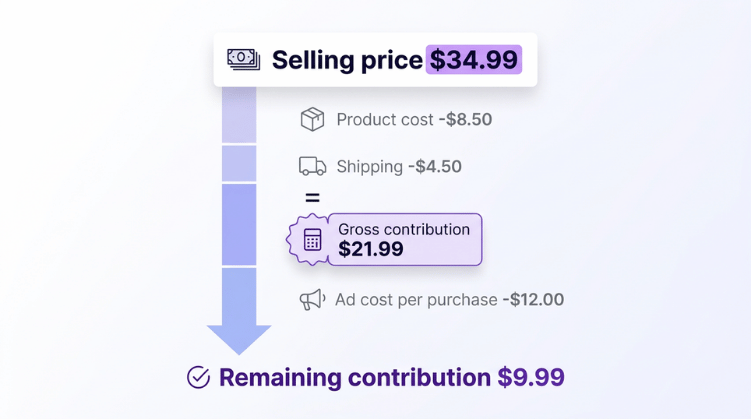
In this example, $21.99 is the maximum amount available before advertising and other applicable costs.
That means an advertising cost of $21.99 per purchase would leave approximately $0 before other expenses such as refunds, payment costs, taxes, discounts, or platform fees.
So the practical break-even calculation is:
Break-even ad cost = selling price − product cost − shipping − other per-order costs
Do not treat a specific product price range or profit-per-order figure as a universal dropshipping rule. Your acceptable numbers depend on the category, customer acquisition cost, return rate, payment fees, shipping, taxes, and business model.
The objective is simply to make sure there is enough economic room to acquire customers profitably.
Step 6: Score, Shortlist, and Test Small
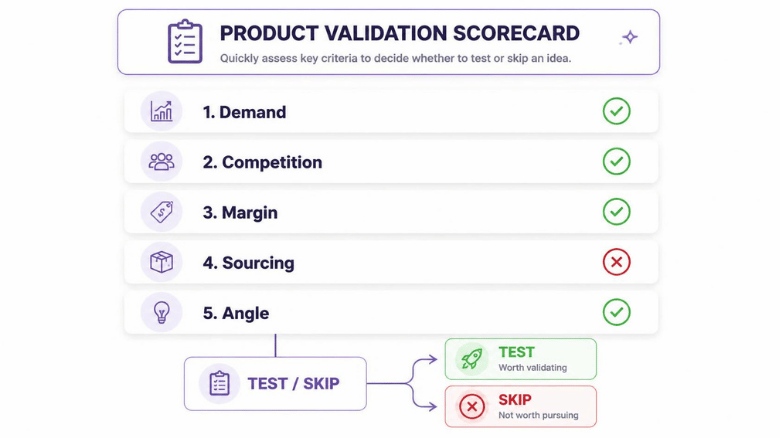
Now put every product through the same checklist.
The purpose is not to predict a guaranteed winner. It is to eliminate products that clearly fail important requirements before you spend money testing them.
A product that fails several important checks should usually be removed from the shortlist.
But passing the checklist does not mean the product is proven.
Nobody can guarantee a winning product from research alone.
Research reduces uncertainty. A real customer test provides the next layer of evidence.
Start with a controlled budget, define your stop conditions in advance, and evaluate the actual results before increasing spend.
How xPage Drop Helps You Test Low Competition Products Faster
Finding a product is only half the process.
The other challenge is getting from product idea → store → checkout → fulfillment without spending weeks assembling separate systems.
xPage Drop is designed as a managed ecommerce and dropshipping infrastructure service. Its current documentation describes capabilities including storefront infrastructure, managed checkout, customer payment collection, order administration, supplier routing, sourcing and fulfillment coordination, buyer support, settlement, and eligible seller payouts. Availability can depend on seller eligibility, configuration, location, and applicable terms.
That can simplify the testing process.
A basic workflow looks like:
Find a product → Set your price → Build the selling page → Start testing → Receive orders → Supplier fulfillment → Settlement/payout
The important part is that product research should still happen before you commit significant advertising spend.
For each product, verify:
- Product availability
- Supplier cost
- Destination-specific shipping
- Fulfillment conditions
- Applicable fees
- Product eligibility
- Your expected selling price
- Your potential contribution after costs
xPage Drop's current product information also shows that order economics can include product cost, destination shipping, handling, payment fees, and other adjustments, so profitability should be calculated from the actual product and destination rather than assumed from a generic margin.
This makes the platform relevant to low competition products because a shorter setup process can let you move from research to testing without building the entire operational workflow from scratch.
Ready to Test Your First Product?
You now have a repeatable way to shortlist low competition dropshipping products.
The process is simple:
Find demand → identify direct competitors → investigate the gap → calculate the economics → test with a controlled budget.
The objective is not to find a product with literally no competition.
It is to find a product where demand exists, competition is manageable, the economics work, and you have a clear reason for customers to choose your offer.
Once you have a product that passes those checks, the next step is putting it in front of real buyers.
Start building your xPage Drop store and test your first product.
Frequently Asked Questions
- How many competitors is too many for dropshipping?
- There is no universal number. For this research method, fewer than five visible direct competitors can be used as a starting threshold for further investigation, not as proof that a market is open. A product with more competitors can still be viable if demand is strong and you have a differentiated offer. A product with almost no competitors can still fail if demand is weak.
- Is low competition always good?
- No. Low competition can indicate an opportunity, but it can also indicate weak demand, sourcing problems, shipping difficulties, advertising limitations, or product-quality issues. Always investigate why competition is low.
- How do I find products before they become highly competitive?
- Look for early demand signals rather than relying on one viral post. Useful sources include: Google Trends TikTok search TikTok Creative Center Pinterest Trends Customer reviews Reddit and niche communities Seasonal buying patterns TikTok Creative Center provides trend, product and advertising research tools, while Pinterest Trends provides historical search, save and shopping data for selected regions.
- Can I find untapped products for free?
- Yes. You can perform much of the initial research using free tools such as Google Trends, TikTok Creative Center, Pinterest Trends, Google Search, Google Shopping, and the Meta Ad Library. Paid research tools can save time, but they are not required to perform the basic validation process.
- How much should I spend testing a low competition product?
- There is no universal testing budget. Set your maximum test budget before launching and calculate your break-even acquisition cost from the product's actual economics. Your goal is not to spend as much as possible. It is to gather enough evidence to decide whether the product deserves further testing.