
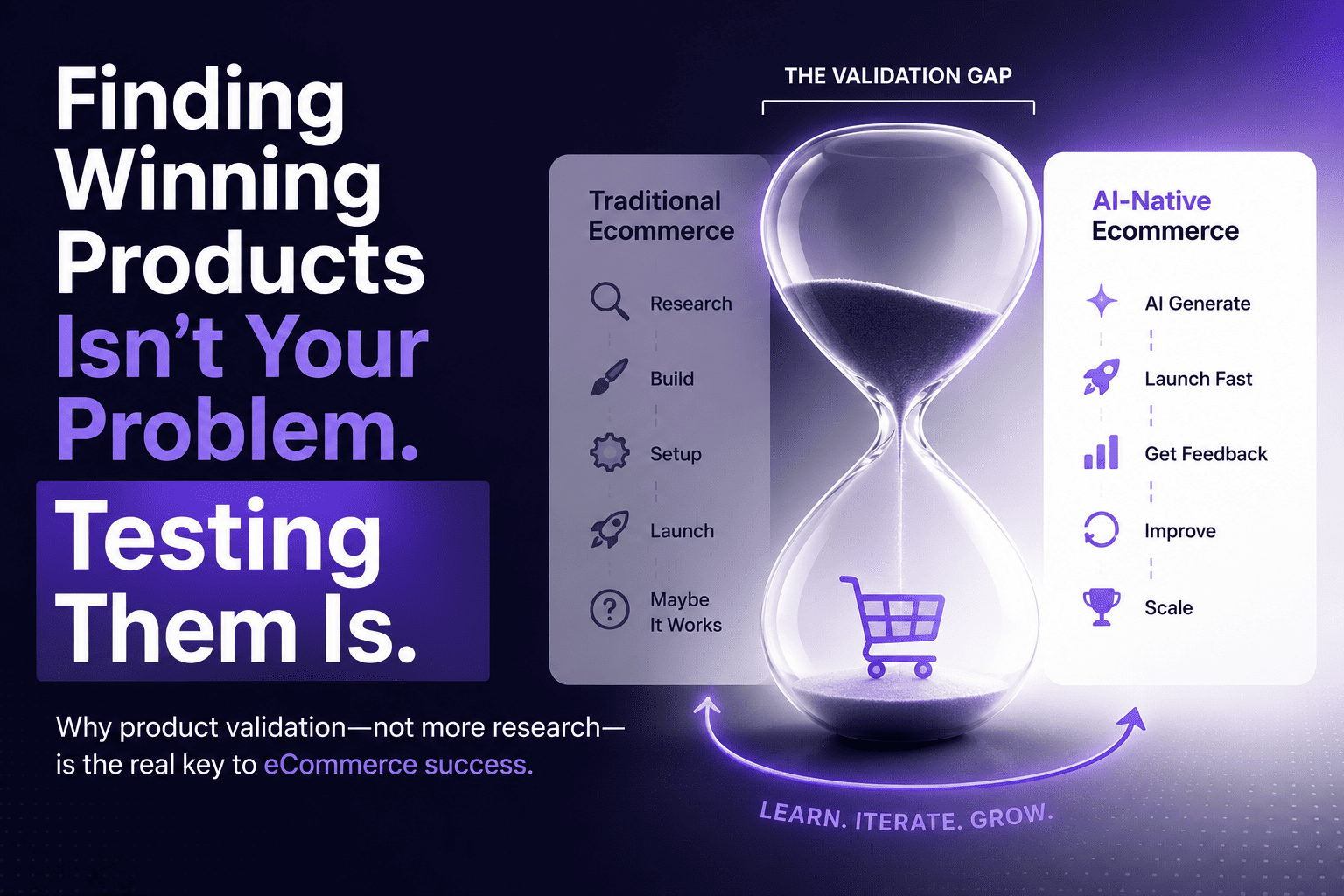
Finding Winning Products Isn't Your Problem. Testing Them Is.
Every year, millions of entrepreneurs launch ecommerce businesses believing success depends on finding one thing: the winning product.
They spend hours scrolling through TikTok, studying Meta ads, analyzing Amazon best sellers, and paying for product research tools that promise to reveal the next big opportunity. Entire YouTube channels, Discord communities, and online courses have been built around the same promise: find the right product, and success will follow.
But if that were true, thousands of entrepreneurs selling the exact same trending products would all become profitable.They don't!
Some build seven-figure brands around products that looked completely ordinary when they launched. Others fail with products that everyone else calls "winners."
So what separates them?
- It isn't luck.
- It isn't access to secret suppliers.
- And it certainly isn't discovering products nobody else knows about.
The difference is something far less exciting, but infinitely more valuable.
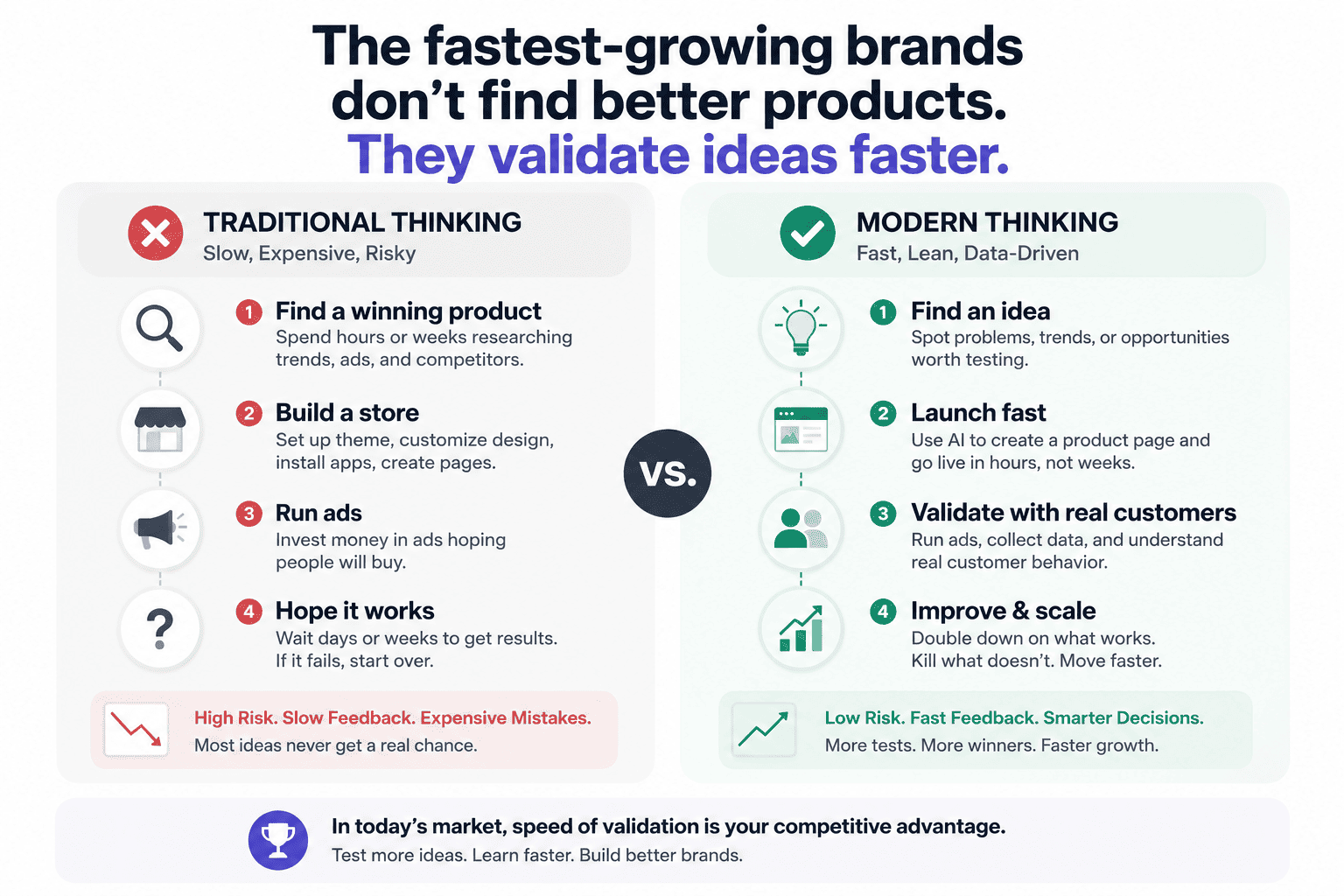
They validate ideas faster than everyone else.
Modern ecommerce has quietly shifted from a game of product discovery to a game of product validation.
Twenty years ago, information was the competitive advantage. If you found a product before everyone else, you had time to dominate the market. Today, information is everywhere. Trending products appear on TikTok within hours. Winning Facebook ads are visible through public ad libraries. Amazon best sellers update continuously. Product research platforms surface the same opportunities to thousands of merchants simultaneously.
Finding ideas is no longer difficult , executing on those ideas is.
The entrepreneurs building the fastest-growing ecommerce brands aren't necessarily better at spotting opportunities. They're better at answering one question faster than everyone else:
Will customers actually buy this?
That answer doesn't come from product research tools.It comes from the market.
The faster you can move from an idea to a real product page, launch it, collect customer feedback, and improve it, the faster you reduce uncertainty—and uncertainty is the single biggest cost in ecommerce.This is why the future doesn't belong to founders who spend months searching for the perfect product. It belongs to founders who can test ten ideas while everyone else is still debating one. That's the shift AI is creating.
Not by magically predicting winning products, but by dramatically reducing the time between having an idea and knowing whether that idea deserves to become a business. Because in 2026, the biggest competitive advantage isn't finding better products. It's building a better validation system.
 The Biggest Lie in Ecommerce
The biggest lie in ecommerce is that winning products are discovered fully formed , they are not.A product becomes a winner only after the market proves it can attract attention, create desire, overcome objections, and convert customers profitably. That proof does not come from a product research dashboard. It comes from real customer behavior.
This is where many beginners get trapped. They believe the hard part is finding a product nobody else has found yet. So they spend weeks searching for the perfect item: something trending but not saturated, cheap but high perceived value, simple but emotionally compelling, viral but not copied. The problem is that by the time a product looks obviously promising, thousands of other sellers may already be looking at the same signals.
Product research tools can show what is trending. They can show what competitors are selling. They can show what ads are running. But they cannot guarantee that your audience, offer, pricing, page, creative angle, and brand experience will convert.
That is why “winning product” is often the wrong mental model. A better mental model is this: a product idea becomes valuable only when it survives validation. Validation means real customers saw the product and responded with measurable behavior. They clicked. They stayed. They added to cart. They purchased. They complained about price. They asked questions. They bounced. They showed you what was working and what was not.
Without that feedback, a product is only a hypothesis.And ecommerce does not reward hypotheses. It rewards tested systems.
The Hidden Cost of Slow Validation
Most ecommerce entrepreneurs don't realize they're competing on speed. They think they're competing on product selection, advertising budgets, or creative quality. While all of those matter, they overlook the one advantage that compounds faster than anything else: learning speed.
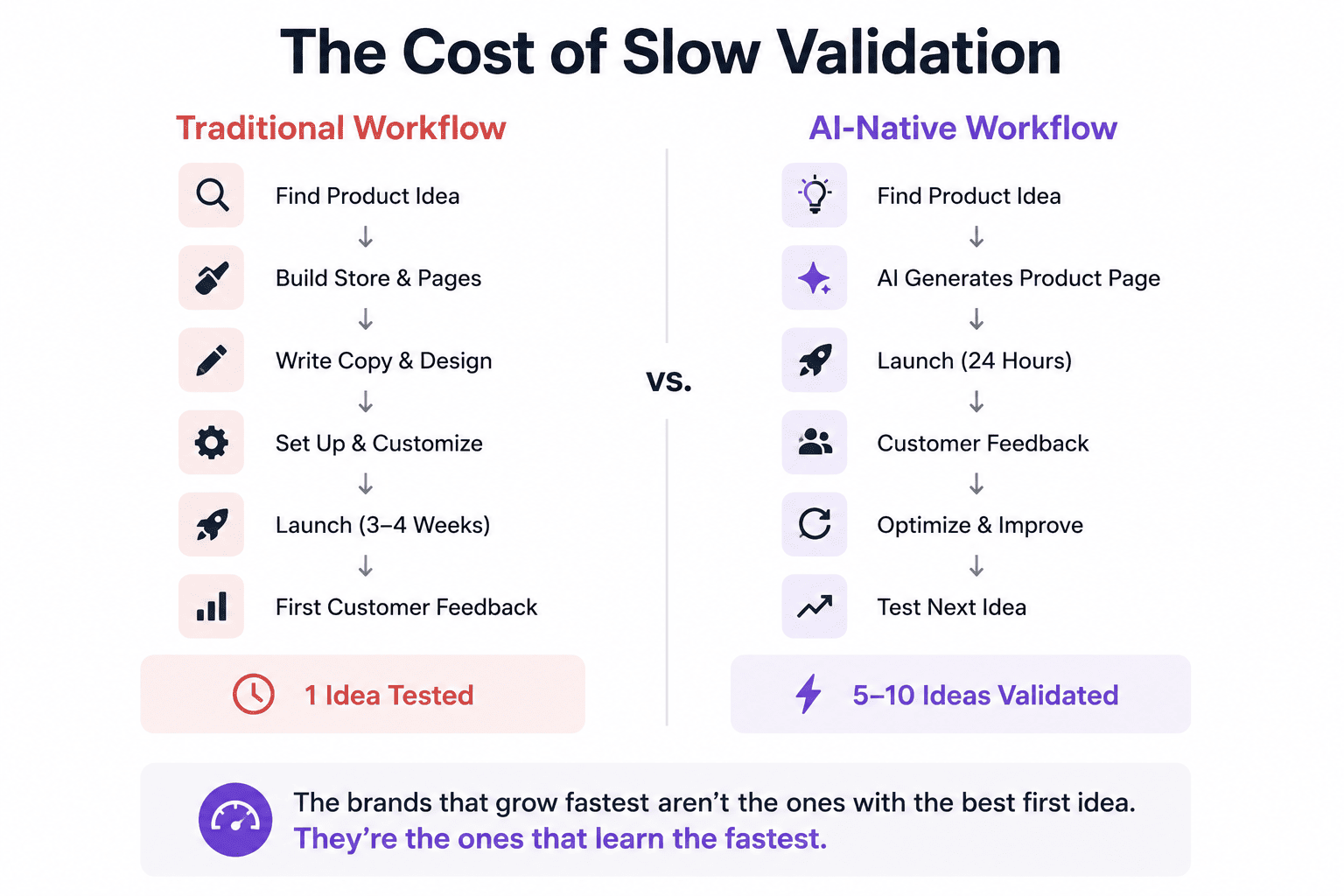
Imagine two entrepreneurs discovering the exact same product on the same day. The first spends three weeks building the "perfect" store. They compare themes, customize every section, rewrite product descriptions, install apps, tweak colors, and wait until everything feels polished before launching. The second takes a different approach. They create a focused product experience, launch within 24 hours, spend a small budget driving traffic, and immediately begin collecting real customer feedback. Within days, they know whether customers understand the offer, whether the pricing feels right, whether objections are being addressed, and whether the product deserves further investment.
By the time the first entrepreneur finally launches, the second has already tested multiple iterations, improved the page, refined the offer, or moved on to an entirely new product.Both started with the same idea ,only one learned faster.
This is the hidden cost of slow validation. Every extra day spent preparing instead of testing delays the only feedback that truly matters: customer behavior.
In today's ecommerce landscape, where trends emerge and disappear within weeks, delayed learning is expensive. According to Shopify, ecommerce conversion rates typically range between 2% and 3%, meaning that the vast majority of visitors will not buy on their first visit. Every launch is therefore an opportunity to gather insights, not just sales. At the same time, Baymard Institute reports that the average cart abandonment rate remains close to 70%, highlighting just how many potential customers leave before completing a purchase. Those numbers reinforce a simple truth: the first version of almost any product page is rarely the best one.
The brands that consistently outperform competitors understand this. They don't expect perfection on day one. They expect learning. Instead of asking, "How do we launch the perfect product?", they ask, "How quickly can we learn what the market actually wants?"
That shift changes everything. Because in modern ecommerce, the most valuable asset isn't a winning product.It's a fast feedback loop.
 The Validation Gap: The Metric Nobody Measures
Most ecommerce entrepreneurs track dozens of metrics.They monitor click-through rates, cost per click, return on ad spend, average order value, and conversion rates. These metrics are essential because they help explain how a business is performing after it launches.
But very few entrepreneurs measure the metric that determines how quickly their business improves.We call it The Validation Gap.
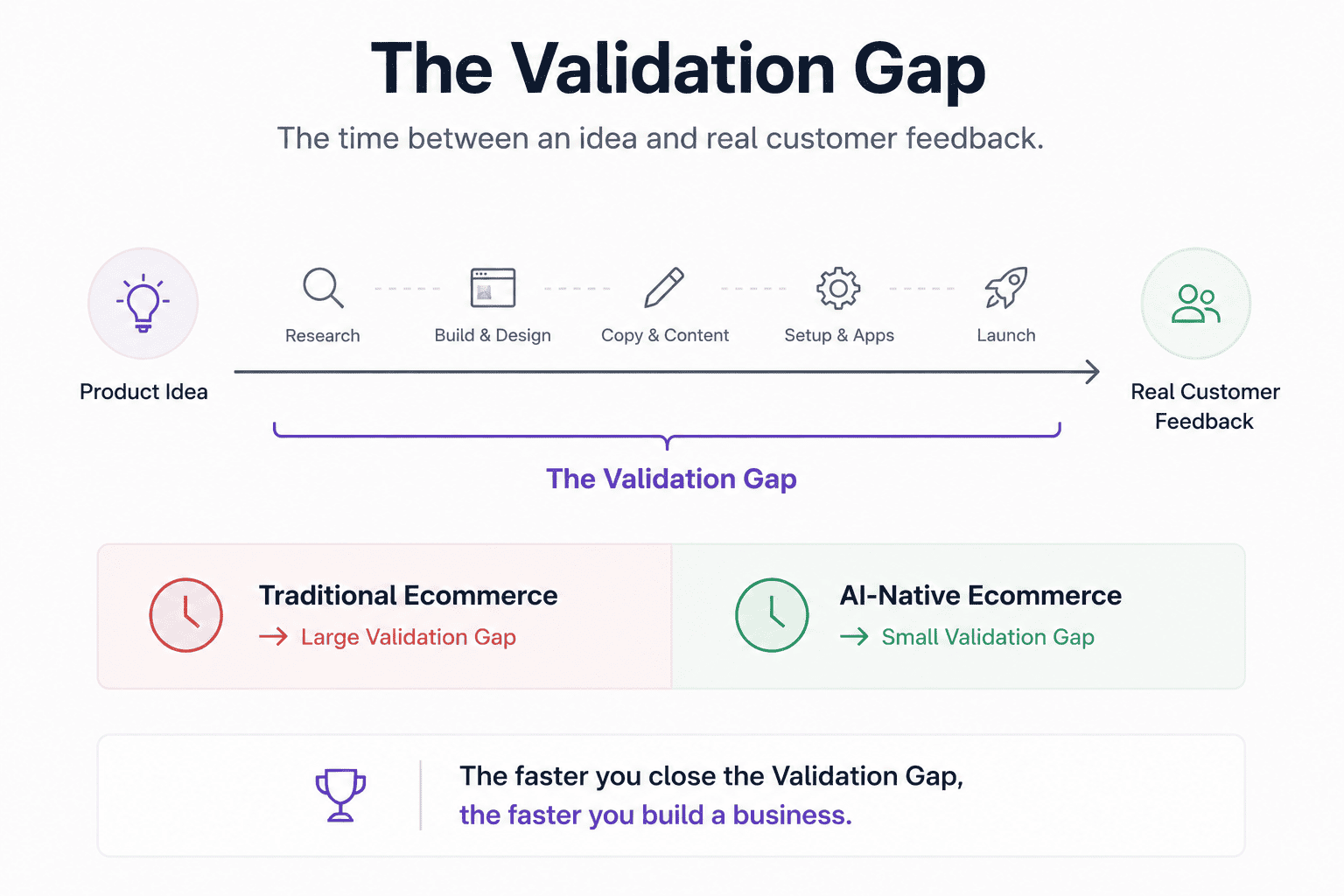
The Validation Gap is the amount of time between having a product idea and collecting enough real customer data to make an informed business decision.In other words, it's the distance between thinking and knowing.Every day spent inside that gap is a day operating on assumptions rather than evidence.
The problem is that traditional ecommerce naturally creates a large Validation Gap. Before most entrepreneurs can even collect their first customer insight, they need to choose a platform, customize a theme, build product pages, write copy, configure payments, install applications, and prepare a launch.None of those tasks tell you whether customers actually want your product. They simply delay the moment when the market can answer that question. The businesses that grow fastest understand that the objective isn't to eliminate uncertainty before launching. That's impossible.
The objective is to eliminate uncertainty after launching, by collecting real customer feedback as quickly as possible. Imagine two brands that discover the same product opportunity. Brand A spends four weeks building the perfect ecommerce store before launching. Brand B launches within forty-eight hours with a focused product experience and immediately begins collecting data. By the end of the month, Brand A has one set of customer feedback. Brand B has tested multiple pricing strategies, refined its messaging, improved its product page, experimented with different audiences, and already knows whether the opportunity is worth scaling.
The difference isn't intelligence.
- It isn't budget.
- It isn't luck.
- It's the size of the Validation Gap.
- Smaller gaps create faster learning.
- Faster learning creates better decisions.
- Better decisions create stronger businesses.
This is why the most valuable companies in the world obsess over experimentation. Amazon famously describes itself as "the best place in the world to fail" because it understands that frequent experimentation leads to faster innovation. The same principle applies to ecommerce. Every product launch is not simply an attempt to make sales, it's an opportunity to generate knowledge that competitors don't have.
The brands that consistently outperform the market are not necessarily better at predicting what customers want. They're simply better at shortening the time it takes to find out.
AI Doesn't Find Winning Products. It Finds Them Faster.
When people talk about AI in ecommerce, the conversation usually revolves around productivity.
- AI writes product descriptions.
- AI generates images.
- AI creates ad copy.
- AI builds landing pages.
All of those capabilities are valuable, but they miss the bigger picture.
The real impact of AI isn't that it performs individual tasks faster. It's that it fundamentally changes how quickly businesses can learn.
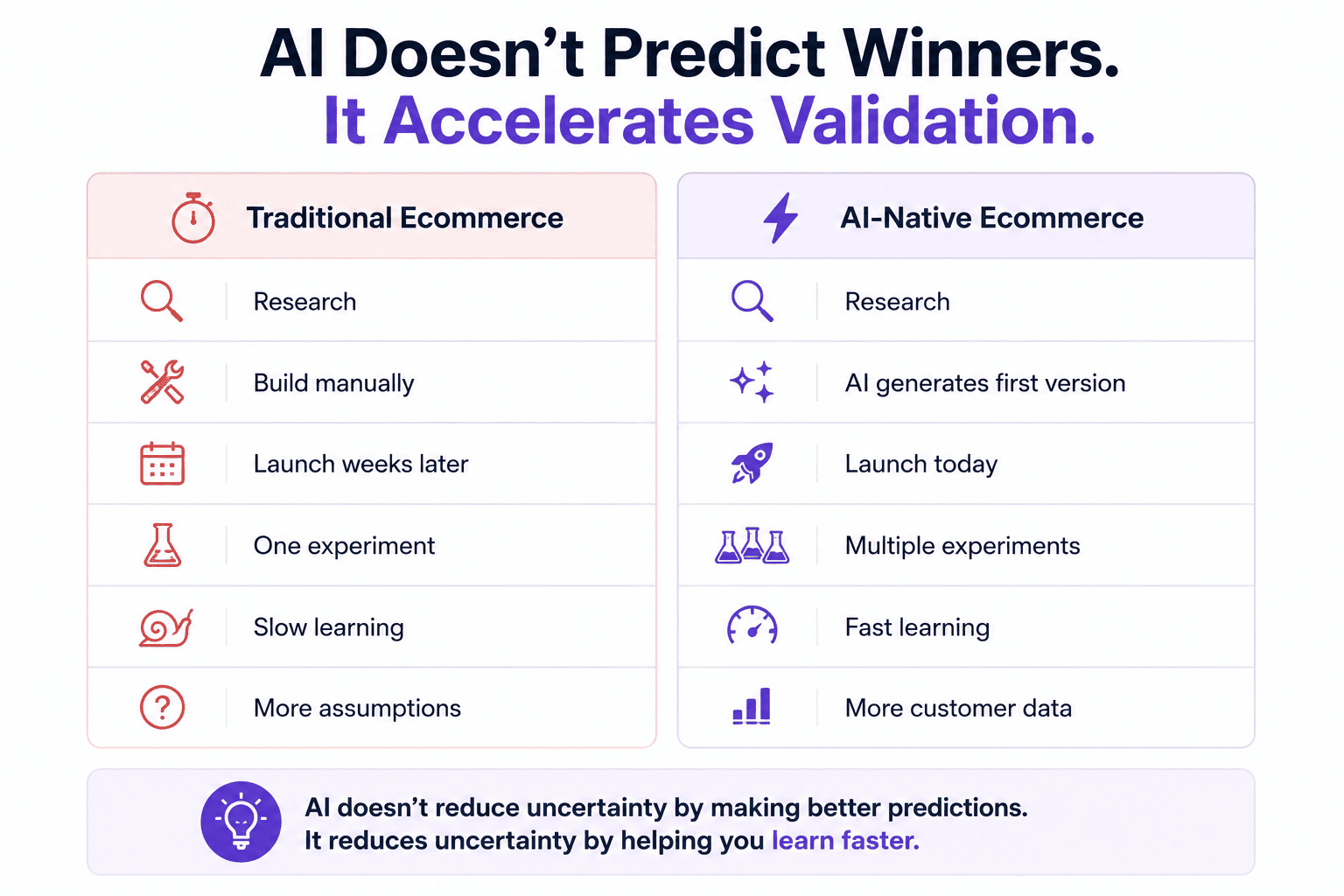
For years, launching a new product required significant manual work. Even after identifying a promising opportunity, entrepreneurs still had to build a store, design a product page, write persuasive copy, organize content, optimize images, configure checkout, and prepare the entire buying experience before they could collect a single piece of customer feedback.Every one of those steps added time. And every extra day increased the Validation Gap. AI compresses that process.
Instead of spending days creating the first version of a product experience, entrepreneurs can generate it in minutes, launch sooner, and begin collecting real market data almost immediately. That shift may seem incremental, but its business impact is enormous.
Imagine two founders with the same product idea.The first spends three weeks preparing a launch before discovering customers aren't interested. The second launches in a single afternoon using AI, collects customer behavior within days, realizes the positioning needs improvement, adjusts the page, tests a new audience, and gathers another round of feedback before the first founder has even finished polishing their homepage. The second founder doesn't have better instincts.
They simply have a faster learning cycle.
This is why AI-native businesses are beginning to outperform traditional ecommerce workflows. They're not relying on AI to make decisions for them, they're using AI to shorten the distance between an assumption and a verified insight. Every faster launch creates another opportunity to learn. Every additional experiment increases the probability of discovering a profitable combination of product, audience, messaging, pricing, and offer.
Research from McKinsey has repeatedly shown that organizations capable of accelerating experimentation and iteration create competitive advantages that compound over time. Ecommerce follows the same principle. Businesses that can test more ideas in the same amount of time naturally gather more market knowledge than competitors moving through slower, manual workflows.
- This is the real promise of AI.
- Not better content.
- Not prettier websites.
- Not automatic success.
--> Faster validation.
Because in modern ecommerce, the founders who learn the fastest rarely need to guess which product will win. The market tells them.
 The Real Bottleneck Isn't Product Research. It's Store Creation.
If AI has made product research faster, why are so many entrepreneurs still taking weeks to launch?Because product research was never the biggest bottleneck, store creation was.
Finding a promising product is only the beginning of the journey. Once an entrepreneur decides what to sell, the real work starts. They need to choose a platform, pick a theme, customize layouts, write copy, create product images, organize sections, configure checkout, install apps, optimize the mobile experience, and make countless design decisions before a single customer can interact with the product.
None of these tasks create market validation. They simply delay it. Traditional ecommerce platforms were designed for a different era. Their goal was to help merchants build online stores. Themes, templates, plugins, and page builders were revolutionary because they made website creation accessible to non-developers.
But the market has changed.Today's entrepreneur doesn't wake up thinking:
"I want to build a beautiful online store."
They wake up thinking:
"I have a product idea. I want to know if people will buy it."
Those are two completely different objectives.
Yet most ecommerce platforms still force merchants to follow the same workflow they have followed for more than a decade: build the store first, validate the idea later.That approach made sense when launching an ecommerce business was a months-long project.
It makes far less sense in a world where markets move daily, trends emerge overnight, and AI can generate high-quality content in seconds.The question is no longer:"How can I build a store faster?"The question is:"How can I start learning from customers as quickly as possible?". That subtle shift changes everything.
When store creation becomes a means to an end rather than the end itself, entrepreneurs stop obsessing over themes, layouts, and endless customization. Instead, they focus on what actually grows a business: launching, testing, learning, and improving.This is why store creation is becoming invisible.
The best ecommerce platforms of the next decade won't compete on how many templates they offer or how many plugins they support.They'll compete on how quickly they help entrepreneurs move from an idea to a validated business.Because the faster you reduce the time between an idea and a customer decision, the faster you reduce risk.And in ecommerce, reducing risk is often more valuable than increasing certainty.
Why xPage Was Built
Every major shift in technology creates a new generation of products.The internet created ecommerce platforms. Cloud computing created SaaS. Mobile created app-first businesses.
Today, AI is creating something different, it's changing how businesses are built.
For years, ecommerce platforms have competed by helping merchants build better stores. They introduced more themes, more templates, more plugins, more customization options, and larger app marketplaces. Those innovations made it easier to launch online, but they were all built around the same assumption:The goal is to build a store. We believe that assumption is no longer true. Entrepreneurs don't wake up excited about configuring themes or comparing page builders. They wake up with ideas they want to validate.
They want to know:
- Will customers buy this product?
- Does this offer make sense?
- Is this the right audience?
- Should I improve it or move on?
Those questions aren't answered by building a prettier website.They're answered by reaching the market faster. That's the philosophy behind xPage.
Instead of asking, "How can we make store creation easier?", we asked a different question:
"How can we help entrepreneurs validate ideas faster?"
That single question changed everything.
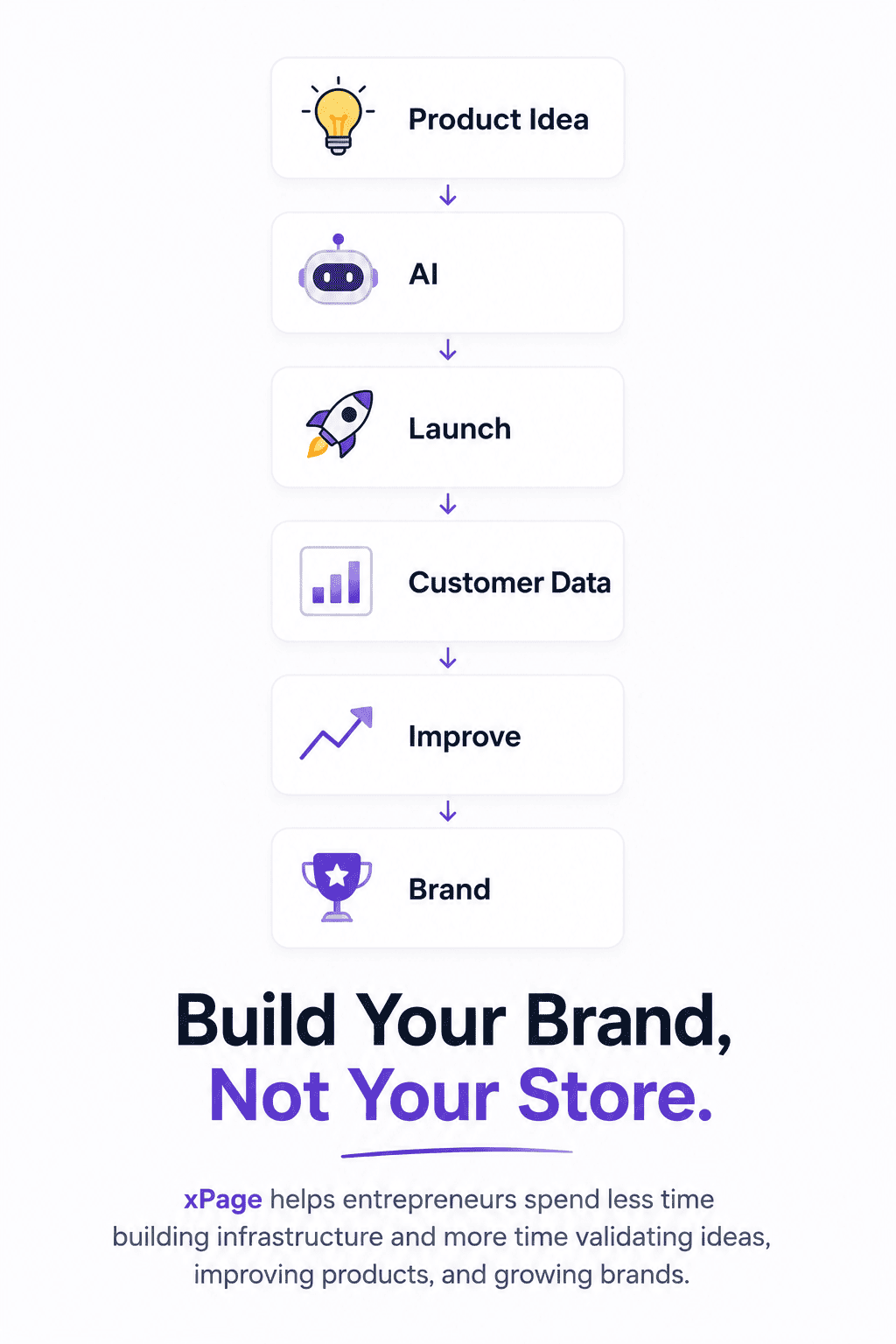
Rather than treating AI as another feature added to an existing ecommerce platform, xPage was designed around an AI-native workflow. Every part of the experience is focused on reducing the time between a product idea and real customer feedback.
Instead of starting with a blank template, you start with a product. Instead of spending hours arranging sections manually, AI generates a conversion-focused product experience. Instead of waiting weeks before learning whether an idea works, you launch, collect data, iterate, and improve.
Because that's what modern ecommerce is really about.Not building stores.Building systems that learn.
The future won't belong to the entrepreneur with the largest app stack or the most customized theme. It will belong to the entrepreneur who can launch ideas, collect feedback, and improve faster than everyone else. That's why xPage wasn't built to replace another website builder.
It was built to support a completely different way of building ecommerce businesses. One where AI doesn't replace entrepreneurs. It removes the friction between an idea and its first customer.
Ready to Validate Your Next Product Faster?
Modern ecommerce isn't about spending weeks building stores before you know whether an idea works. It's about launching, learning, and improving as quickly as possible.
If you're ready to move from product ideas to validated businesses, xPage helps you generate AI-powered product experiences, launch faster, and spend less time building infrastructure.
Build Your Brand, Not Your Store.
→ Start building with xPage for free.
Frequently Asked Questions
- Why is finding winning products no longer enough?
- Because product ideas are widely available. The competitive advantage now comes from validating ideas faster than competitors and learning from real customer behavior.
- What is product validation in ecommerce?
- Product validation is the process of testing a product with real customers to determine whether it has market demand before investing heavily in scaling.
- How does AI help validate products faster?
- AI reduces the time required to create landing pages, product descriptions, and marketing assets, allowing merchants to launch experiments and gather customer feedback much sooner.
- What is the Validation Gap?
- The Validation Gap is the time between having a product idea and collecting enough real customer data to make an informed business decision. Reducing this gap helps businesses learn and grow faster.
- Why do AI-native ecommerce platforms outperform traditional platforms?
- AI-native platforms prioritize rapid experimentation and validation instead of manual store creation, enabling merchants to test more ideas and iterate more quickly.