
Beyond Shopify: The Rise of AI-Native E-Commerce Platforms
Beyond Shopify: The Rise of AI-Native E-Commerce Platforms
For nearly two decades, e-commerce followed the same formula.
Pick a platform.
Install a theme.
Add apps.
Customize pages.
Drive traffic.
Optimize conversions.
Repeat.
It worked because the technology available to merchants was limited. Building a store required designers, developers, copywriters, marketers, and an ever-growing stack of software subscriptions.
Artificial intelligence is changing that equation entirely.
Not by adding another app to the dashboard.
By replacing the dashboard itself.
The next generation of e-commerce winners won't be defined by who has the biggest team or the most expensive agency. They'll be defined by who adopts AI-native infrastructure first.
And that shift is already underway.
The AI Revolution Is Reshaping Retail Faster Than Most Merchants Realize
Most conversations around AI focus on content generation or customer support.
That's surface-level thinking.
The real disruption is happening at the operational layer of commerce.
Artificial intelligence is becoming the engine behind:
- Store creation
- Product page optimization
- Customer acquisition workflows
- Conversion rate optimization
- Product merchandising
- Checkout personalization
- Customer support automation
- Revenue maximization
The most advanced e-commerce AI solutions don't simply automate individual tasks.
They eliminate entire workflows.
What once required multiple tools, multiple subscriptions, and multiple specialists can now happen automatically inside a single ecosystem.
This creates a significant advantage for modern merchants.
Less complexity.
Less friction.
More speed.
More profit.
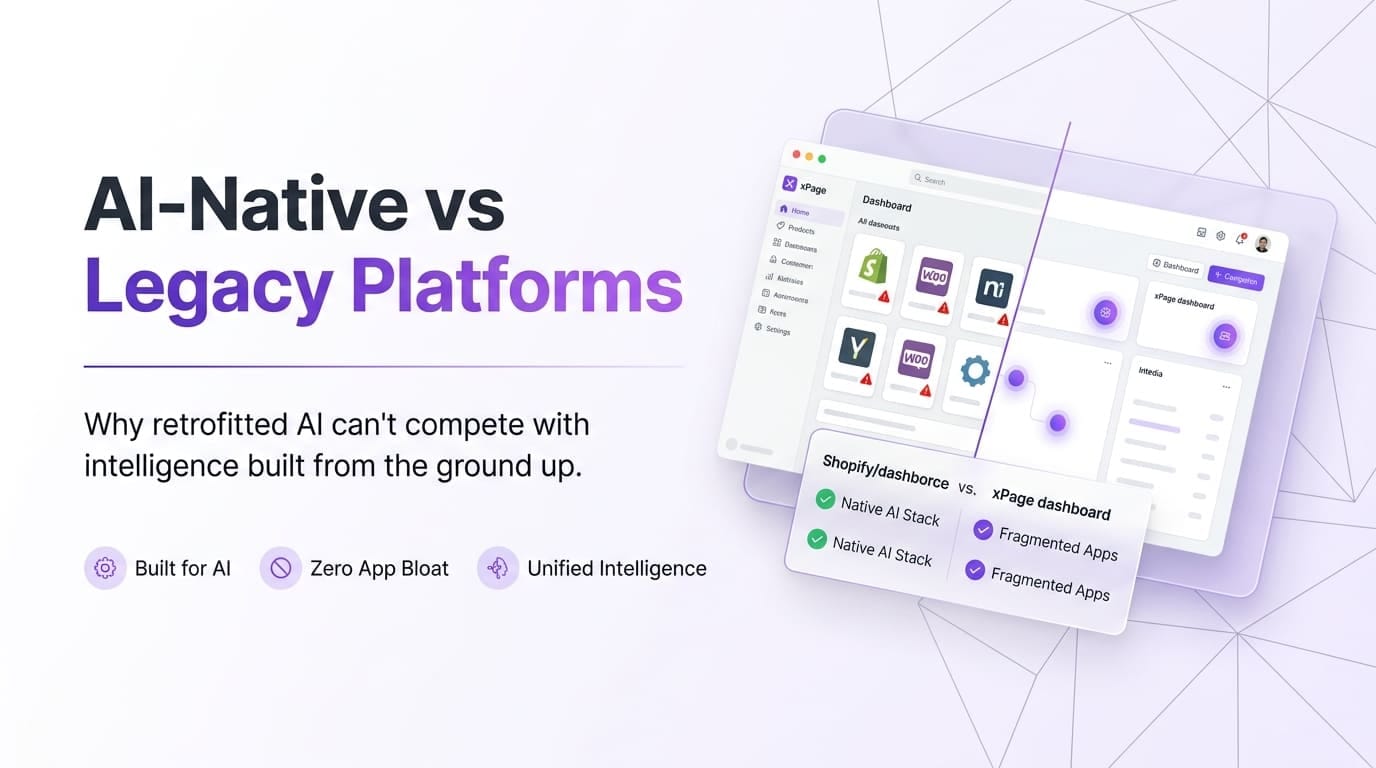
Traditional SaaS platforms were designed before AI became central to online commerce. As a result, most are now trying to retrofit intelligence into infrastructure that was never built for it.
That approach creates limitations.
Native AI systems do not have those limitations.
Why Legacy Store Builders Are Becoming a Bottleneck
Every experienced seller has faced the same situation.
You discover a promising product.
You want to launch immediately.
Instead, you spend hours or days:
- Building pages
- Adjusting layouts
- Installing applications
- Editing product descriptions
- Optimizing images
- Troubleshooting integrations
The market moves faster than your store-building process.
This creates a hidden cost most merchants underestimate.
Lost momentum.
The traditional approach to e-commerce assumes store creation should be manual.
Modern AI challenges that assumption entirely.
If artificial intelligence can generate code, write copy, analyze customer behavior, and optimize conversion paths, why should merchants still build stores piece by piece?
They shouldn't.
The future belongs to automated store creation.
Generic Templates Are Quietly Destroying Conversion Rates
Most online stores look different.
But they feel identical.
Customers land on product pages and immediately encounter the same structure:
- Hero image
- Generic description
- Feature list
- Review section
- Add-to-cart button
The problem isn't aesthetics.
The problem is psychology.
A product page exists for one purpose:
To remove uncertainty.
The highest-converting stores don't simply display products.
They systematically answer questions before customers ask them.
They eliminate objections before customers leave.
They create trust before skepticism appears.
This is where AI-generated commerce experiences become incredibly powerful.
Instead of relying on static templates, intelligent systems can dynamically generate high-converting structures based on product type, customer intent, and proven conversion frameworks.
The result is a product page built around persuasion rather than design trends.
What High-Converting Product Pages Look Like in the AI Era
The best product pages today are no longer handcrafted one section at a time.
They're assembled around data.
Around behavior.
Around intent.
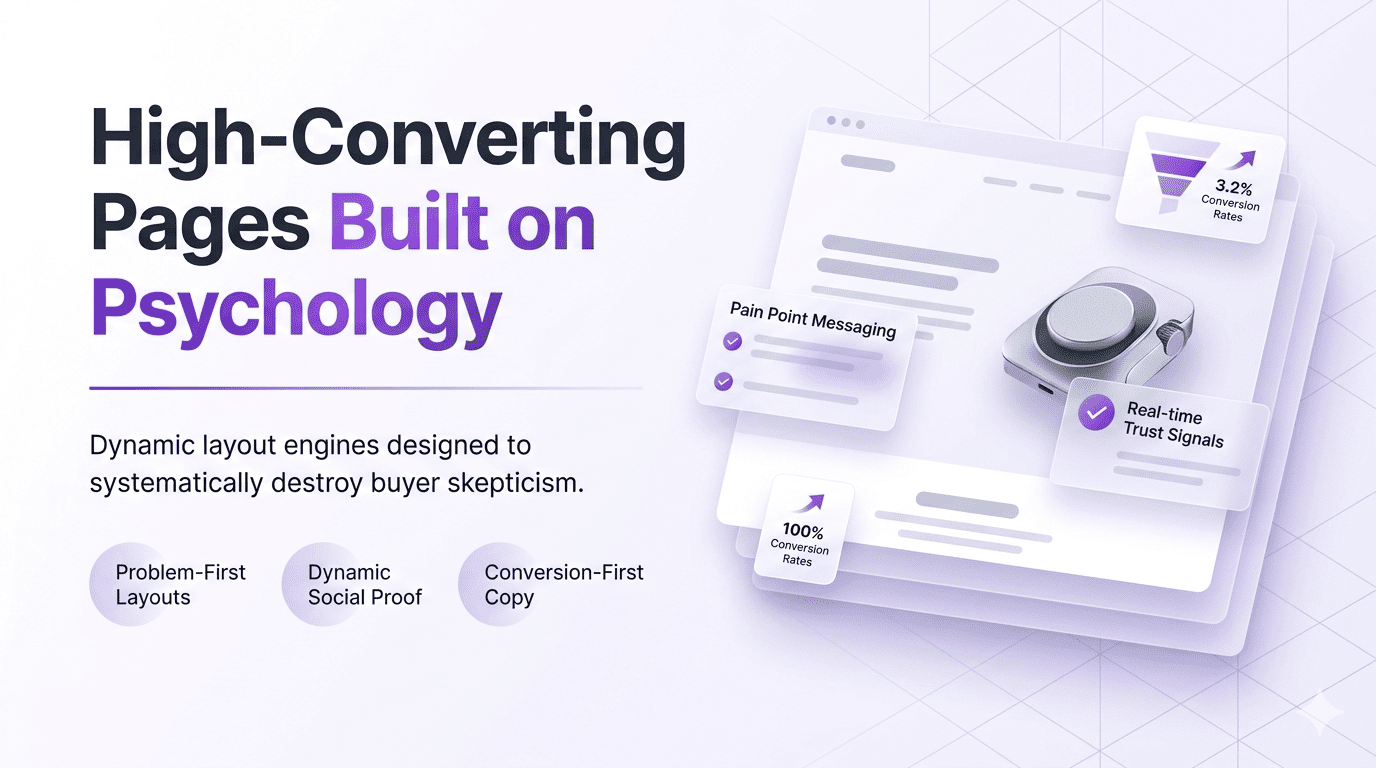
Modern AI-driven product pages typically include:
Problem-First Messaging
Customers buy solutions, not products.
Strong AI systems identify pain points and position products around outcomes rather than specifications.
Intelligent Content Hierarchies
Not every visitor needs the same information.
AI helps structure content based on what drives action first.
Dynamic Social Proof
Reviews, testimonials, and trust signals become contextual rather than static.
Conversion-Focused Design
Every section serves a purpose.
Every element earns its place.
Nothing exists simply because a template included it.
The goal isn't to create a prettier page.
The goal is to create a page that converts more traffic into revenue.
The New Economics of Dropshipping and E-Commerce
Running an online business in 2026 looks very different than it did a few years ago.
Traffic costs have increased.
Competition has intensified.
Consumer attention has fragmented.
Margins have compressed.
The biggest challenge is no longer access to products.
It's execution.
Winning brands launch faster.
Test faster.
Optimize faster.
Scale faster.
This explains why demand for ecommerce automation tools continues growing among serious operators.
Automation isn't about convenience.
It's about survival.
When competitors can launch five stores while you're still configuring one, speed becomes a competitive weapon.
The merchants who embrace automation gain more opportunities to discover winning products before the market becomes saturated.
The AI Tools That Actually Impact Revenue
The market is flooded with AI software.
Most of it creates noise.
A small percentage creates measurable growth.
The most valuable ai tools for e-commerce directly influence conversion rates, average order value, and launch velocity.
AI Product Recommendations
One of the most profitable applications of AI is intelligent merchandising.
Advanced ai product recommendations analyze purchasing patterns and customer behavior to surface the most relevant products at the ideal moment.
The result:
- Higher average order values
- Increased revenue per visitor
- Improved customer experience
AI Shopping Assistants
Modern ai shopping assistants go far beyond answering support questions.
They function like digital sales associates.
They help customers compare products.
They reduce hesitation.
They increase purchase confidence.
When implemented correctly, they become conversion assets rather than support tools.
Automated Store Creation
Perhaps the most disruptive category is fully automated store building.
Instead of manually constructing stores from templates, AI can now generate complete e-commerce experiences from product data alone.
This dramatically reduces launch time while improving consistency and conversion potential.
Why the Best AI Tools for Small E-Commerce Stores Are Becoming Unified Platforms
Merchants searching for the best ai tools for small e-commerce stores 2024 often encounter endless lists of disconnected software.
The assumption is that more tools create more capability.
The opposite is increasingly true.
Every additional tool introduces:
- Additional costs
- Additional complexity
- Additional maintenance
- Additional performance issues
The strongest businesses are moving toward unified systems where automation, conversion optimization, store creation, and product management exist within a single environment.
This shift is creating an entirely new category:
The AI-native commerce platform.
The Difference Between AI-Enhanced and AI-Native Platforms
This distinction matters more than most merchants realize.
An AI-enhanced platform starts with traditional infrastructure and adds intelligence later.
An AI-native platform begins with intelligence at its core.
Every workflow is designed around automation.
Every feature is built around speed.
Every process is optimized for conversion.
One treats AI as an accessory.
The other treats AI as the foundation.
As e-commerce becomes increasingly competitive, foundational advantages compound.
Why xPage Represents the Future of Store Creation
This is where xPage enters the conversation.
xPage wasn't built as another theme builder.
It wasn't designed as another page builder.
And it wasn't created to become another subscription inside an already crowded software stack.
xPage was designed around a simple idea:
Store creation should happen at the speed of product discovery.
When a seller finds a promising product, they shouldn't spend days building a storefront.
They should launch immediately.
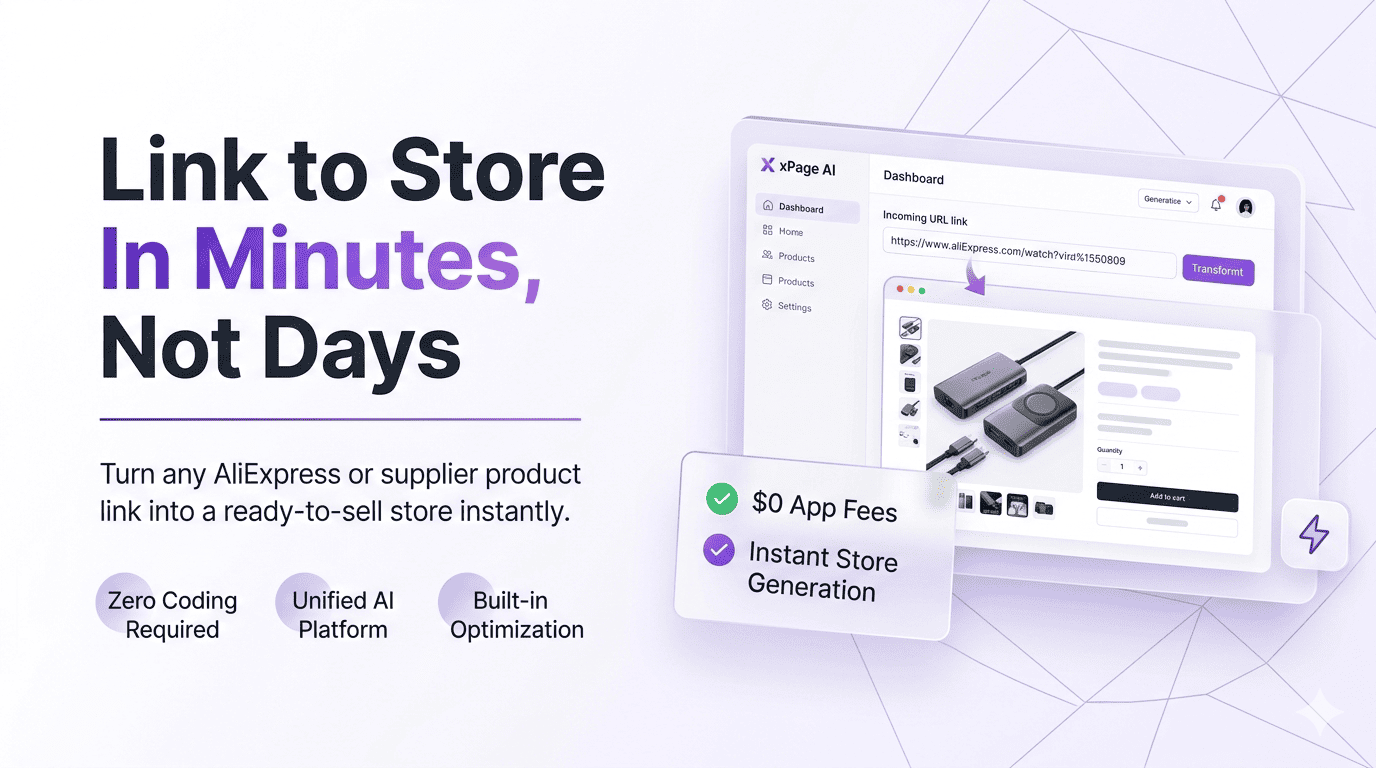
With xPage, a product link can become a ready-to-sell store within minutes.
Product pages are generated automatically.
Sales-focused content is created instantly.
Conversion structures are built without coding.
For dropshippers and e-commerce brands, this solves some of the industry's most frustrating problems:
- Slow store creation
- Poor product page conversions
- Excessive app dependencies
- Technical complexity
- Delayed product testing
Rather than layering AI onto old workflows, xPage replaces those workflows entirely.
That makes it more than another tool.
It positions xPage as a true AI e-commerce platform built for modern commerce realities.
The Next Competitive Advantage
The next wave of successful e-commerce brands won't necessarily have better products.
They'll have better systems.
Better infrastructure.
Better automation.
Better execution speed.
The merchants who continue relying on outdated workflows will spend more time building stores than scaling them.
The merchants who adopt AI-native platforms will spend more time testing products, improving offers, and growing revenue.
That's the real promise of AI in commerce.
Not replacing merchants.
Empowering them to move faster than ever before.
And as the industry evolves, platforms like xPage are increasingly becoming the blueprint for what modern e-commerce infrastructure should look like.