
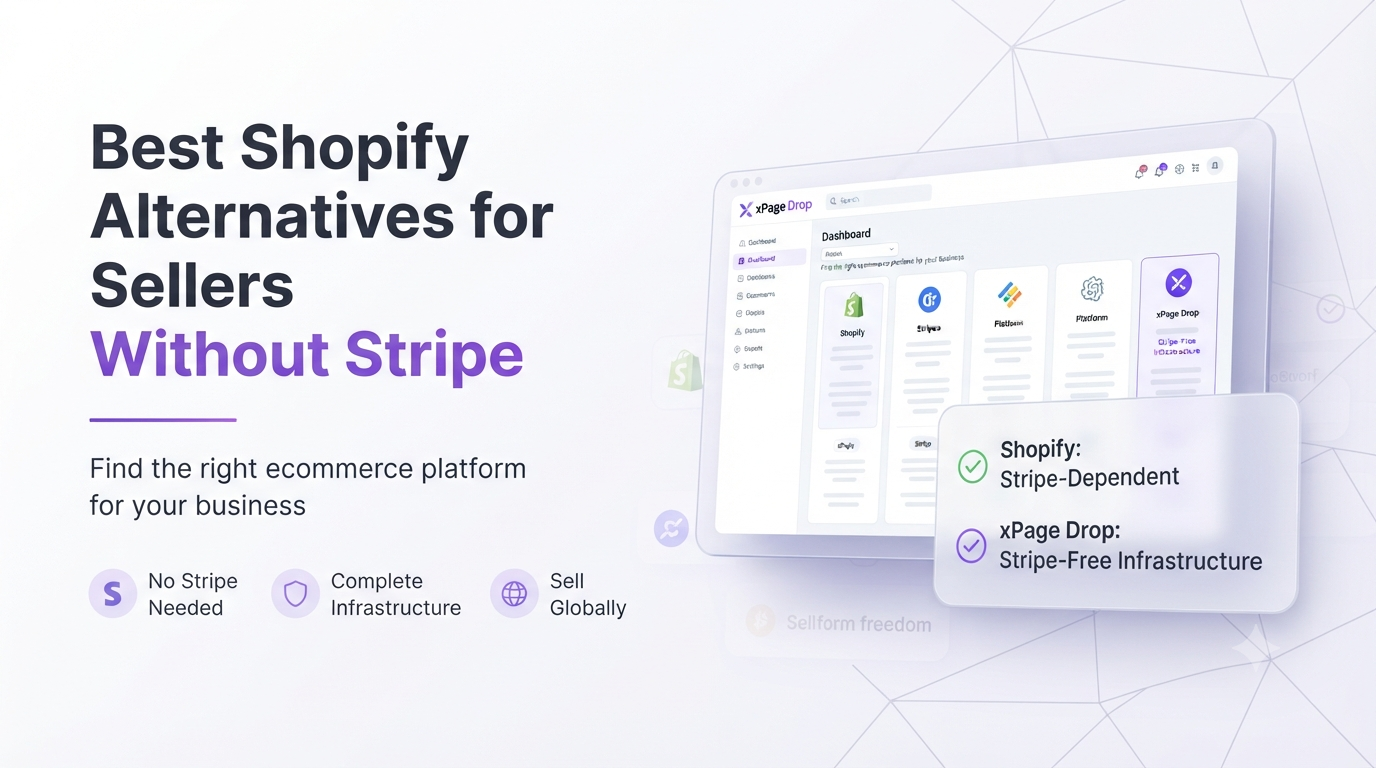
Best Shopify Alternatives for Sellers Without Stripe
Best Shopify Alternatives for Sellers Without Stripe
Shopify has earned its reputation as one of the world's leading ecommerce platforms. From startups launching their first product to global brands processing thousands of orders every day, millions of merchants rely on Shopify to power their online stores.
Its intuitive interface, extensive app ecosystem, and scalable infrastructure make it an attractive choice for businesses of all sizes.
However, Shopify isn't the perfect solution for everyone.
For many entrepreneurs around the world, the biggest challenge isn't building a store—it's accepting payments.
While Shopify supports multiple payment providers, much of its ecosystem is built around Shopify Payments, which is powered by Stripe in supported markets. Merchants operating in countries where Shopify Payments isn't available, or those who cannot access Stripe-based solutions, often face additional complexity when configuring their stores.
As a result, many entrepreneurs begin searching for Shopify alternatives without Stripe.
The good news is that Shopify isn't the only way to build a successful ecommerce business.
The better news is that modern merchants need much more than another storefront builder.
They need infrastructure.
Today's ecommerce businesses require payment flexibility, operational automation, fulfillment coordination, conversion optimization, and business management working together in one connected ecosystem.
That's exactly where xPage Drop takes a different approach.
Rather than functioning as another ecommerce platform, xPage Drop provides AI-native business infrastructure designed to help entrepreneurs build, launch, and scale ecommerce businesses from virtually anywhere.
1. Introduction: Why Shopify Isn't the Only Option
Shopify transformed ecommerce by making it easier for entrepreneurs to launch professional online stores.
For many businesses, it remains an excellent platform.
But ecommerce has changed.
Today's merchants need more than attractive storefronts.
They need systems capable of managing:
- Payments
- Orders
- Fulfillment
- Marketing
- Analytics
- Business operations
For entrepreneurs who cannot access Stripe-supported payment infrastructure, the challenge becomes even greater.
Building a store is easy.
Building a complete business is much harder.
That's why many merchants start researching the best Shopify alternatives for sellers without Stripe.
The objective isn't simply replacing Shopify.
It's finding a platform that removes operational barriers while supporting long-term business growth.
2. The Problem with Shopify for Sellers Without Stripe
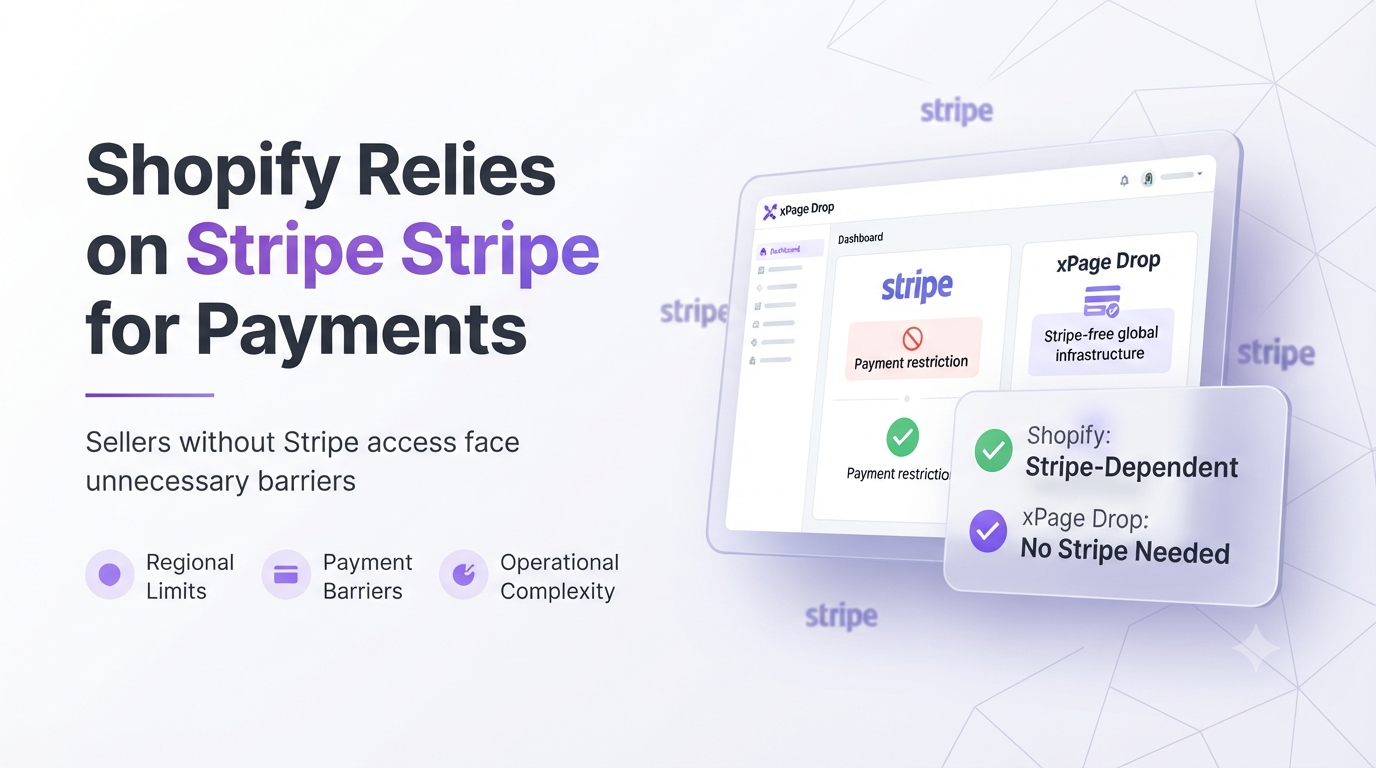
Shopify supports hundreds of payment providers worldwide, and many businesses successfully use alternative gateways depending on their country and business model.
However, merchants in regions where Shopify Payments is unavailable—or where preferred payment providers are limited—may need additional integrations or operational workarounds.
For sellers who cannot rely on Stripe-based solutions, several practical challenges can arise.
Regional Payment Availability
Payment options differ significantly between countries.
Some merchants have access to Shopify Payments and a wide range of supported gateways.
Others must rely on regional providers or third-party integrations.
Operational Complexity
Using multiple independent services for payments, fulfillment, and operations can increase business complexity over time.
Scaling Challenges
As ecommerce businesses grow, merchants often need:
- Better operational workflows
- More automation
- Unified reporting
- Integrated fulfillment
- Payment flexibility
Many sellers discover that the challenge isn't Shopify itself.
It's building an efficient business ecosystem around it.
That's why entrepreneurs frequently search for an ecommerce platform without Stripe that supports broader operational needs.
3. Best Shopify Alternatives Compared
Below are some of the strongest platforms for merchants looking beyond Shopify.
Each platform serves different business models and operational priorities.
1. xPage Drop
Website: https://xpage.ai/drop
xPage Drop approaches ecommerce differently.
Instead of focusing solely on website creation, it combines AI-powered business creation with connected operational infrastructure.
Features include:
- AI-powered ecommerce creation
- Integrated payment infrastructure
- Order management
- Fulfillment coordination
- Conversion-focused landing pages
- Business automation
- Analytics
- Global commerce support
Best for:
Merchants seeking an AI-native platform that simplifies operations while supporting international ecommerce growth.
2. WooCommerce
Website: https://woocommerce.com/
WooCommerce provides a highly customizable ecommerce solution built on WordPress.
Advantages include:
- Open-source flexibility
- Large plugin ecosystem
- Complete website ownership
Best for:
Businesses wanting maximum customization.
3. BigCommerce
Website: https://www.bigcommerce.com/
BigCommerce offers enterprise-ready ecommerce functionality with strong native features.
Strengths include:
- Multi-channel selling
- Scalable architecture
- Built-in ecommerce capabilities
Best for:
Growing ecommerce brands.
4. Wix Ecommerce
Website: https://www.wix.com/ecommerce
Wix combines visual website building with ecommerce capabilities.
Benefits include:
- Easy editing
- Fast setup
- Beginner-friendly interface
Best for:
Small businesses launching quickly.
5. Ecwid
Website: https://www.ecwid.com/
Ecwid allows merchants to add ecommerce functionality to existing websites.
Highlights include:
- Lightweight setup
- Multi-channel selling
- Easy integration
Best for:
Businesses expanding existing websites.
6. Shopware
Website: https://www.shopware.com/
Shopware is an open commerce platform offering flexibility for growing businesses.
Strengths include:
- API-first architecture
- Enterprise capabilities
- High customization
Best for:
Businesses requiring advanced ecommerce infrastructure.
7. Adobe Commerce (Magento)
Website: https://business.adobe.com/products/magento/magento-commerce.html
Adobe Commerce delivers extensive ecommerce customization and scalability.
Features include:
- Enterprise functionality
- Advanced customization
- Large developer ecosystem
Best for:
Large ecommerce operations.
8. PrestaShop
Website: https://prestashop.com/
PrestaShop provides an open-source ecommerce platform used by merchants worldwide.
Advantages include:
- Flexible customization
- Large community
- Extensive modules
Best for:
Businesses wanting open-source control.
9. OpenCart
Website: https://www.opencart.com/
OpenCart offers lightweight ecommerce functionality with a broad extension marketplace.
Strengths include:
- Simple administration
- Open-source platform
- Extensive add-ons
Best for:
Small to medium ecommerce businesses.
10. Squarespace Commerce
Website: https://www.squarespace.com/ecommerce-website
Squarespace combines website design with ecommerce functionality.
Highlights include:
- Beautiful templates
- Easy editing
- Integrated ecommerce
Best for:
Brands emphasizing design.
Comparison Overview
When evaluating Shopify alternatives without Stripe, merchants should compare much more than storefront functionality.
Important considerations include:
- Payment flexibility
- AI capabilities
- Automation
- Fulfillment
- Order management
- Analytics
- Conversion optimization
- International selling
- Operational integration
- Scalability
The strongest platform isn't simply the one with the most features.
It's the one that removes the most operational friction.
4. Why Most Platforms Aren't Enough
Most ecommerce platforms specialize in one aspect of online selling.
Some build websites.
Others focus on storefront customization.
Some prioritize design.
Others emphasize plugins and integrations.
The challenge is that modern ecommerce businesses require multiple systems working together.
Merchants often find themselves managing:
- Website software
- Payment providers
- Fulfillment tools
- Marketing platforms
- Analytics dashboards
- Supplier systems
As businesses grow, maintaining these disconnected systems becomes increasingly difficult.
Entrepreneurs spend valuable time integrating software rather than improving products, serving customers, or expanding into new markets.
The future of ecommerce isn't another plugin.
It's connected infrastructure.
5. Introducing xPage Drop: Complete Infrastructure
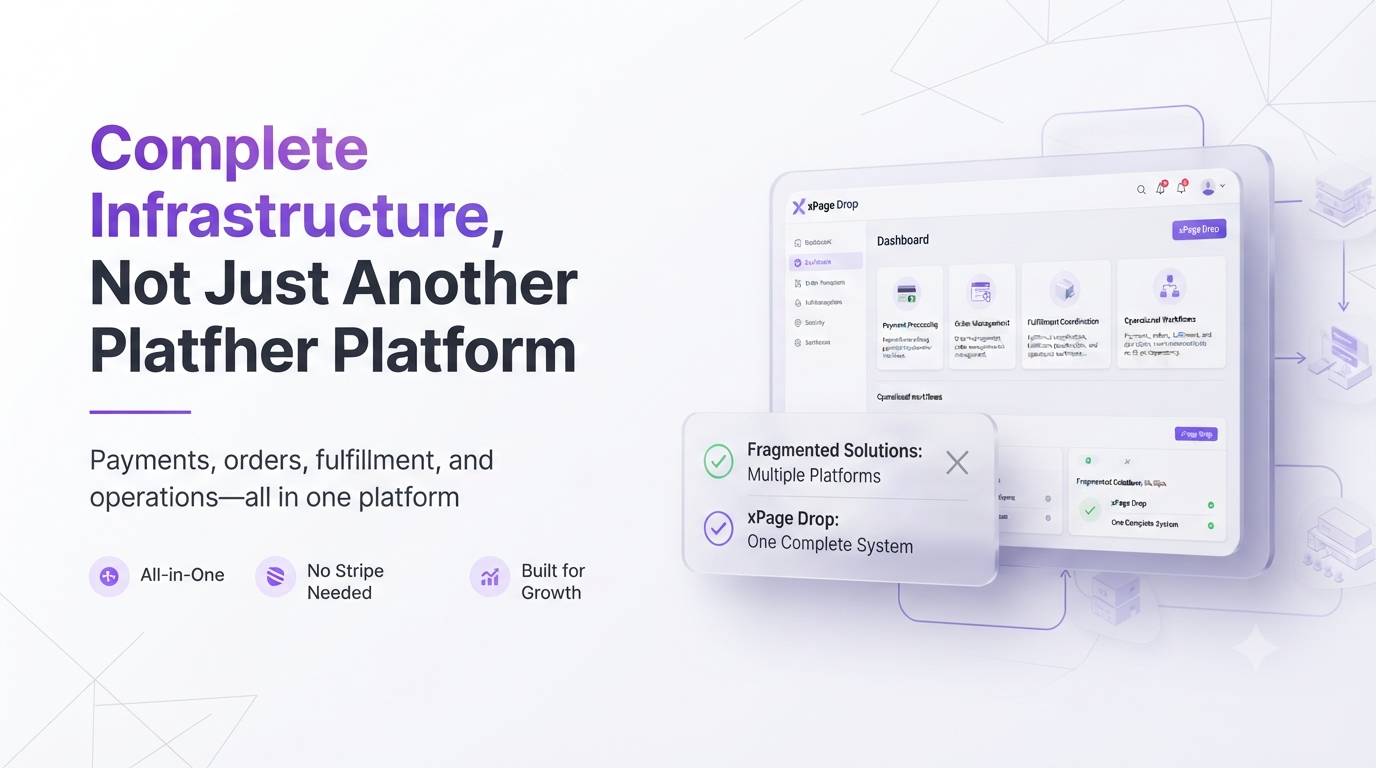
xPage Drop was designed around a different vision.
Instead of becoming another website builder, it serves as an AI-native operating system for ecommerce businesses.
Its purpose is simple:
Help entrepreneurs build businesses—not just online stores.
xPage Drop combines:
- AI-powered ecommerce creation
- Payment infrastructure
- Order management
- Fulfillment coordination
- Conversion optimization
- Operational automation
- Analytics
- Business scalability
For merchants searching for an ecommerce platform without Stripe, xPage Drop offers more than a checkout solution.
It provides connected infrastructure that simplifies every stage of running an online business.
Instead of managing multiple software platforms, merchants operate from one integrated ecosystem.
This reduces operational complexity while helping businesses grow faster.
6. FAQ
What are the best Shopify alternatives for sellers without Stripe?
Some of the strongest best Shopify alternatives for sellers without Stripe include xPage Drop, WooCommerce, BigCommerce, Wix Ecommerce, Ecwid, Shopware, Adobe Commerce, PrestaShop, OpenCart, and Squarespace Commerce.
Can I build an ecommerce store without Stripe?
Yes.
Many merchants successfully use an ecommerce platform without Stripe by selecting payment providers and platforms that support their location and business model.
What is the best Stripe alternative for dropshipping?
The best Stripe alternative for dropshipping depends on your country, operational needs, and preferred business workflow.
Merchants should evaluate payment flexibility alongside fulfillment, automation, and operational infrastructure.
What payment gateway should dropshippers use?
The ideal payment gateway for dropshipping varies depending on your target markets, supported countries, and business requirements.
Reliability, scalability, and operational integration are all important factors.
Why isn't another ecommerce platform enough?
Building a business requires more than a storefront.
Merchants also need connected payments, fulfillment, automation, analytics, and operational workflows.
7. Conclusion: Start Selling Without Stripe Today
Shopify remains one of the world's leading ecommerce platforms.
For many businesses, it continues to be an excellent solution.
But it isn't the only path to building a successful online business.
Entrepreneurs who cannot access Stripe-supported payment infrastructure have more choices than ever before.
The most successful businesses increasingly choose platforms that simplify operations instead of adding more software to manage.
That's exactly why xPage Drop exists.
Rather than functioning as another ecommerce platform, it provides AI-native infrastructure that combines payments, fulfillment, automation, analytics, conversion optimization, and business management into one connected ecosystem.
Ready to Sell Without Stripe?
If you're researching Shopify alternatives without Stripe, don't just compare website builders.
Choose a platform designed to help you run your entire business.
With xPage Drop, you can manage payments, coordinate fulfillment, automate operations, optimize conversions, and grow internationally from one AI-powered platform.
Because successful ecommerce businesses aren't built on disconnected tools.
They're built on connected infrastructure.
Start selling without Stripe today with xPage Drop.