
10 Best Cartpanda Alternatives in 2026
10 Best Cartpanda Alternatives in 2026
Selecting the right ecommerce platform is one of the most important decisions an online business can make. Your platform affects everything from storefront creation and payment processing to order management, fulfillment, customer experience, and long-term growth.
Cartpanda has become a well-known name among ecommerce entrepreneurs, particularly in the dropshipping community. Its focus on conversion-optimized checkout experiences, ecommerce tools, and marketing features has made it an attractive option for many merchants.
However, no ecommerce platform is the perfect fit for every business.
Some merchants want more automation.
Some need broader payment flexibility.
Others are looking for AI-powered workflows that reduce manual work and accelerate growth.
Many simply want one platform that manages their entire business instead of requiring multiple disconnected tools.
That's why more entrepreneurs are researching Cartpanda alternatives.
The ecommerce software market has expanded rapidly, offering merchants more choices than ever before. The challenge isn't finding alternatives—it's identifying which platform aligns best with your business goals.
In this guide, we'll compare ten of the best Cartpanda alternatives, examine how today's leading Cartpanda competitors differ, and explain why complete business infrastructure is becoming the future of ecommerce.
1. Introduction: Why Merchants Look for Cartpanda Alternatives
Every ecommerce business operates differently.
Some brands focus on high-converting landing pages.
Others prioritize product sourcing.
Many want advanced automation.
Some need stronger operational workflows.
As businesses grow, their software requirements evolve.
A platform that works perfectly during launch may eventually become limiting as order volume, international expansion, and operational complexity increase.
This is why many merchants begin evaluating Cartpanda alternatives.
Common reasons include:
- Expanding internationally
- Looking for AI-powered business tools
- Simplifying operations
- Improving automation
- Increasing payment flexibility
- Managing fulfillment more efficiently
- Reducing reliance on multiple third-party applications
Ultimately, merchants aren't simply looking for another platform.
They're looking for a better operating system for ecommerce.
2. What Cartpanda Does Well (and Where It Falls Short)
Cartpanda has built a strong reputation by helping merchants create ecommerce stores with an emphasis on conversion and ease of use.
Where Cartpanda Performs Well
Many businesses choose Cartpanda because it offers:
- Conversion-focused checkout
- Ecommerce store management
- Marketing features
- Sales funnel capabilities
- User-friendly interface
These capabilities make Cartpanda attractive for businesses that want to launch online stores quickly while improving conversion performance.
Where Some Merchants Look Elsewhere
As ecommerce businesses scale, some merchants begin searching for additional capabilities such as:
- AI-powered workflows
- More comprehensive automation
- Integrated payment infrastructure
- Business-wide operational management
- Fulfillment coordination
- Global commerce capabilities
- Connected analytics
These aren't necessarily weaknesses.
Rather, they reflect changing business requirements as ecommerce operations become more sophisticated.
Many merchants eventually realize they need infrastructure—not simply another storefront builder.
3. 10 Best Cartpanda Alternatives Compared
The ecommerce market now offers numerous dropshipping platform alternatives, each serving different business needs.
Below are ten of the strongest best Cartpanda alternatives available in 2026.
1. xPage Drop
Website: https://xpagedrop.com/
xPage Drop approaches ecommerce differently from traditional platforms.
Instead of focusing solely on store creation, it provides AI-powered business infrastructure that supports merchants throughout the entire ecommerce journey.
Key features include:
- AI-powered ecommerce creation
- Payment infrastructure
- Order management
- Fulfillment coordination
- Conversion-focused landing pages
- Business automation
- Operational workflows
- Global commerce support
Best for:
Businesses seeking an AI-native ecommerce platform for dropshipping that combines payments, fulfillment, operations, and growth in one connected platform.
2. Shopify
Website: https://www.shopify.com/
Shopify remains one of the world's largest ecommerce ecosystems.
Strengths include:
- Extensive app marketplace
- Large theme ecosystem
- Strong developer support
- Broad integrations
Best for:
Businesses seeking maximum flexibility through third-party applications.
3. WooCommerce
Website: https://woocommerce.com/
WooCommerce provides a highly customizable ecommerce solution built on WordPress.
Advantages include:
- Full customization
- Open-source flexibility
- Large plugin ecosystem
Best for:
Businesses comfortable managing their own hosting environment.
4. BigCommerce
Website: https://www.bigcommerce.com/
BigCommerce focuses on scalable ecommerce for growing businesses.
Highlights include:
- Enterprise functionality
- Multi-channel commerce
- Strong native ecommerce features
Best for:
Scaling ecommerce brands.
5. Wix Ecommerce
Website: https://www.wix.com/ecommerce
Wix combines visual website creation with ecommerce functionality.
Key benefits include:
- Easy website editing
- Fast store setup
- Beginner-friendly interface
Best for:
New ecommerce businesses.
6. AutoDS
Website: https://www.autods.com/
AutoDS specializes in ecommerce automation.
Features include:
- Product importing
- Automated ordering
- Inventory synchronization
- Supplier management
Best for:
Dropshippers focused on operational automation.
7. Zendrop
Website: https://www.zendrop.com/
Zendrop emphasizes fulfillment and supplier relationships.
Highlights include:
- Product sourcing
- Supplier network
- Faster shipping options
- Order fulfillment
Best for:
Businesses prioritizing supplier management.
8. Spocket
Website: https://www.spocket.co/
Spocket connects merchants with suppliers located primarily in the United States and Europe.
Advantages include:
- Faster shipping opportunities
- Regional suppliers
- Curated product selection
Best for:
Brands focused on customer experience.
9. CJdropshipping
Website: https://cjdropshipping.com/
CJdropshipping combines sourcing and logistics into one platform.
Features include:
- Product sourcing
- Warehousing
- Global fulfillment
- Private labeling
Best for:
Businesses seeking integrated sourcing and logistics.
10. DSers
Website: https://www.dsers.com/
DSers is widely used for AliExpress automation.
Highlights include:
- Bulk ordering
- Supplier optimization
- Product mapping
- Inventory management
Best for:
AliExpress-focused dropshipping businesses.
Comparison Overview
When evaluating Cartpanda competitors, merchants should compare more than storefront features.
Important evaluation criteria include:
- AI capabilities
- Payment flexibility
- Product sourcing
- Fulfillment
- Automation
- Conversion optimization
- Operational workflows
- Analytics
- Scalability
- Ease of use
The best platform isn't necessarily the one with the most features.
It's the one that removes the most operational complexity.
4. Why Most Platforms Aren't Enough
Many ecommerce platforms specialize in solving one problem.
Some build websites.
Some focus on automation.
Others emphasize fulfillment.
Some prioritize checkout optimization.
The challenge is that successful ecommerce businesses require all these systems working together.
Without connected infrastructure, merchants often depend on multiple software platforms:
- One for the website
- One for payments
- One for fulfillment
- One for supplier management
- One for analytics
- One for marketing
As businesses scale, this fragmented approach becomes increasingly difficult to manage.
Time spent maintaining software integrations is time not spent growing the business.
Modern ecommerce increasingly favors unified infrastructure over disconnected software stacks.
5. Introducing xPage Drop: Complete Infrastructure
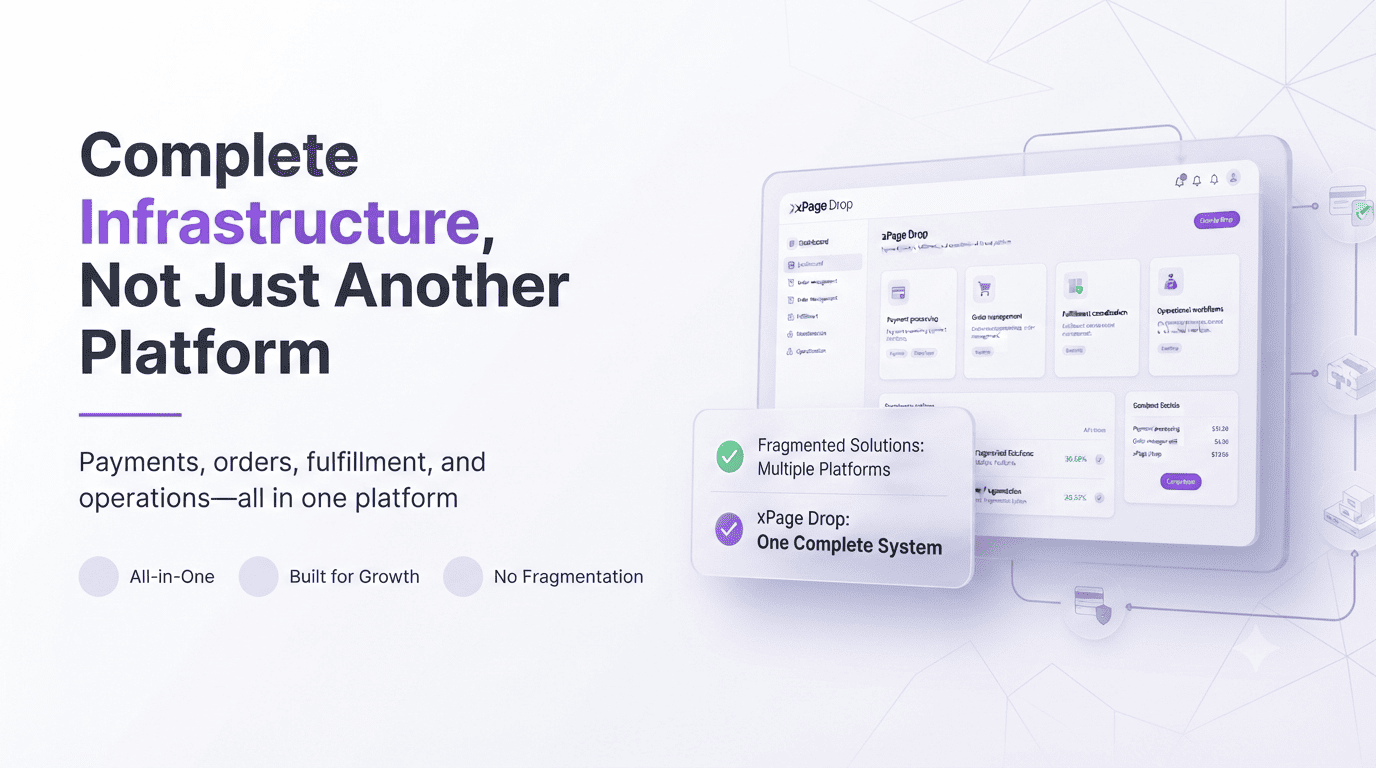
xPage Drop was built around a different philosophy.
Rather than becoming another entry in the list of Cartpanda alternatives, it aims to simplify ecommerce by providing connected business infrastructure.
Its mission is straightforward:
Help entrepreneurs build businesses—not simply online stores.
xPage Drop combines:
- AI-powered ecommerce
- Payment infrastructure
- Order management
- Fulfillment coordination
- Conversion optimization
- Business automation
- Operational workflows
- Analytics
Instead of asking merchants to assemble several independent services, xPage Drop brings essential ecommerce capabilities together into one AI-native ecosystem.
This reduces operational complexity while helping businesses launch faster and scale more efficiently.
For merchants evaluating dropshipping platform alternatives, xPage Drop offers more than another ecommerce platform.
It provides the infrastructure modern ecommerce businesses need.
Because successful businesses require connected systems—not disconnected software.
6. FAQ
What are the best Cartpanda alternatives?
Some of the leading best Cartpanda alternatives include xPage Drop, Shopify, WooCommerce, BigCommerce, Wix Ecommerce, AutoDS, Zendrop, Spocket, CJdropshipping, and DSers.
Why do merchants look for Cartpanda competitors?
Businesses often seek additional AI capabilities, automation, payment flexibility, fulfillment options, operational efficiency, or greater scalability.
Which ecommerce platform is best for dropshipping?
The ideal ecommerce platform for dropshipping depends on your business goals. Important considerations include automation, fulfillment, payments, scalability, ease of use, and operational integration.
Are all dropshipping platforms the same?
No.
Different platforms specialize in different areas, including product sourcing, automation, fulfillment, storefront creation, and business management.
Why is connected infrastructure becoming more important?
As ecommerce businesses grow, managing multiple disconnected platforms becomes increasingly inefficient.
Integrated infrastructure reduces operational complexity while improving scalability.
7. Conclusion: Start Selling Today
Choosing an ecommerce platform is about more than comparing feature lists.
It's about selecting the foundation your business will rely on as it grows.
While Cartpanda remains a strong choice for many merchants, it isn't the ideal solution for every ecommerce business.
Today's market offers numerous Cartpanda alternatives, each designed to serve different business models and operational priorities.
The most successful ecommerce businesses increasingly choose platforms that simplify operations instead of adding more software to manage.
That's exactly why xPage Drop exists.
Instead of functioning as another ecommerce platform, it provides AI-native infrastructure that brings together payments, fulfillment, automation, conversion optimization, and business management into one connected ecosystem.
Ready to Build More Than Just a Store?
If you're evaluating Cartpanda alternatives, think beyond individual features and choose the infrastructure that will support your business as it grows.
With xPage Drop, you can launch faster, streamline operations, manage payments and fulfillment, optimize conversions, and scale globally from one AI-powered platform.
Because successful ecommerce businesses aren't built on disconnected tools.
They're built on connected infrastructure.
Start selling today with xPage Drop.